Hukuman Mati di Malaysia

Apakah hukuman mati di Malaysia?

  • Malaysia adalah antara 56 negara yang menjalankan hukuman mati. Hukuman mati di Malaysia menggunakan teknik gantung iaitu menggunakan tali yang dipasang di leher untuk mematahkan tengkuk pesalah.
  • Perkara 5(1) Perlembagaan Persekutuan menyatakan bahawa ‘tiada seorang pun boleh diambil nyawanya atau dilucutkan kebebasan dirinya kecuali mengikut undang-undang’. Dengan peruntukan ini, sistem perundangan negara dibenarkan untuk melaksanakan hukuman mati ke atas kesalahan-kesalahan tertentu.
  • Sehingga kini, terdapat 32 kesalahan di bawah 8 akta berbeza yang mempunyai peruntukan hukuman mati. Daripada 32 kesalahan ini, 11 kesalahan memperuntukkan hukuman mati mandatori di mana hukuman mati adalah satu-satunya hukuman yang boleh dan wajib dikenakan ke atas individu yang didapati bersalah.

Apakah Tahap Pelaksanan Hukuman Mati di Malaysia?

  • Sehingga Disember 2018, jumlah pesalah yang sedang menunggu pelaksanaan hukuman mati di penjara Malaysia adalah berjumlah 1,281 orang. Mengikut istilah kepenjaraan, pesalah yang telah dijatuhi hukuman mati dipanggil banduan akhir.
  • Sejumlah 56% banduan akhir adalah rakyat Malaysia manakala selebihnya adalah warganegara asing. 89% banduan akhir adalah lelaki dan baki 11% adalah wanita.
  • Menurut Menteri di Jabatan Perdana Menteri yang bertanggung jawab atas hal ehwal undang-undang, Datuk Liew Vui Keong, kos pelaksanaan hukuman gantung yang ditanggung kerajaan adalah sebanyak RM1,975 bagi setiap pesalah dan setiap hukuman mengambil masa kurang 15 saat untuk dilaksanakan. RM800 turut disediakan kerajaan bagi tujuan pengkebumian sekiranya mayat pesalah tidak dituntut waris atau keluarga.
  • Pesalah yang telah dijatuhi hukuman mati masih lagi boleh mengemukakan petisyen untuk mengurangkan bentuk hukuman kepada Lembaga Pengampunan selari dengan Perkara 42 Perlembagaan Persekutuan. Bagi tempoh 2007 sehingga 2017, seramai 165 orang banduan akhir telah diberi pengampunan menerusi Lembaga Pengampunan. Hukuman yang dikurangkan kebiasaannya adalah kepada penjara seumur hidup atau penjara selama 20 tahun.
  • Kali terakhir pindaan undang-undang dibuat berkaitan hukuman mati adalah pada tahun 2017 apabila Akta Dadah Berbahaya 1952 dipinda bagi membolehkan mahkamah menentukan sama ada seseorang pesalah pengedaran dadah dijatuhi hukuman mati atau dipenjara seumur hidup, dan bukan hukuman mati mandatori seperti asalnya.
  • Pindaan tahun 2017 ini hanya terpakai bagi kes-kes yang belum diputuskan mahkamah pada masa itu. Mengikut undang-undang terkini, pesalah yang telah dijatuhi hukuman mati oleh mahkamah sebelum pindaan ini dibuat masih perlu menjalani hukuman mereka.
  • Walaupun pindaan 2017 ini menggugurkan hukuman mati mandatori, para hakim masih lagi terikat dengan peruntukan hukuman mati sekiranya yang tertuduh tidak memenuhi syarat-syarat tertentu. Peruntukan double presumptions atau sangkaan berganda menyukarkan keadaan di mana seseorang yang ditahan kerana memiliki dadah melebihi jumlah tertentu akan turut dianggap terlibat dalam aktiviti pengedaran dadah. Sekiranya pihak tertuduh tidak dapat membuktikan mereka tidak terlibat dalam aktiviti pengedaran, maka para hakim masih perlu menjatuhkan hukuman mati ke atas mereka. Walau bagaimanapun, peruntukan anggapan berganda ini telah dimansuhkan oleh Mahkamah Persekutuan pada bulan Mei lalu.

Apakah perkembangan terkini?

  • Soal pemansuhan hukuman mati mandatori telah timbul sejak beberapa tahun lalu. Bekas Peguam Negara, Tan Sri Apandi Ali pada tahun 2015 pernah menyatakan bahawa beliau akan mencadangkan kepada kabinet untuk memansuhkan hukuman mati mandatori untuk semua kesalahan bagi memberi ruang kepada hakim untuk menentukan hukuman.
  • Pakatan Harapan menerusi Janji 27 manifesto Pilihan Raya Umum ke-14 (PRU14) tahun lalu telah menjanjikan pemansuhan hukuman mati mandatori. Namun beberapa isu pelaksanaan jelas kelihatan, dengan beberapa pendapat serta kenyataan pemimpin yang bercanggah berhubung tahap pemansuhan. 
  • Pada 10 Oktober 2018, Menteri Undang-Undang Datuk Liew Vui Keong mengesahkan bahawa hukuman mati mandatori akan dimansuhkan. Beliau juga menyatakan bahawa kerajaan telah bersetuju agar pelaksanaan hukuman mati bagi pesalah yang telah dijatuhkan hukuman setakat itu ditangguhkan (moratorium) sehingga keputusan akhir dan pindaan undang-undang dibuat. Menurutnya juga, pembentangan pindaan undang-undang kepada akta berkaitan akan dibuat pada sidang Parlimen yang akan bermula pada bulan tersebut.
  • Tidak lama kemudian pada 15 Oktober 2018, Datuk Liew Vui Keong menyatakan keperluan pemansuhan hukuman mati bagi semua kesalahan, bukan sahaja hukuman mati mandatori. Beliau turut menyatakan cadangan hukuman penjara minimum 30 tahun bagi menggantikan hukuman mati apabila dimansuhkan kelak. 
  • Seolah-olah mengesahkan perkara ini, pada 13 November 2018 Datuk Liew Vui Keong menngumumkan bahawa Mesyuarat Jemaah Menteri telah bersetuju untuk memansuhkan kesemua hukuman mati secara penuh. Namun begitu, sehari selepas kenyataan ini, Datuk Seri Dr Wan Azizah memberi kenyataan bahawa kerajaan masih lagi mempertimbangkan cadangan pemansuhan hukuman mati termasuklah cadangan pemansuhan terma mandatori.
  • Walaubagaimanapun, pada Disember lalu Malaysia buat pertama kalinya menyokong Resolusi Perhimpunan Agung Pertubuhan Bangsa-Bangsa Bersatu (PBB) bagi mengisytihar moratorium atas pelaksanaan hukuman mati. Ini merupakan pembentangan kali ketujuh resolusi tersebut dibuat di Perhimpunan Agung PBB.
  • Percanggahan kenyataan-kenyataan dari pihak Kerajaan mungkin mencerminkan perdebatan umum tentang hukuman mati. Kumpulan yang menyokong pemansuhan hukuman mati memberi justifikasi berdasarkan hak asasi manusia dan kegagalan hukuman tersebut dalam memerangi jenayah manakala mereka yang membantah pula masih percaya hukuman mati adalah hukuman setimpal untuk jenayah berat dan kejam. Pada masa yang sama, kumpulan hak asasi manusia seperti Lawyers for Liberty dan Amnesty’s Malaysia telah tampil untuk mengkritik keputusan kerajaan yang dikatakan hanya akan memansuhkan hukuman mati mandatori berbanding kenyataan pemansuhan sepenuhnya. 
  • Masyarakat umum seperti memihak kepada penerusan hukuman mati. Suatu tinjauan ringkas oleh News Straits Times dan Berita Harian menerusi saluran media sosial mendapati 82% daripada 22,000 responden tinjauan tersebut tidak bersetuju hukuman mati dimansuhkan. Namun, tinjauan ringkas tentang hukuman mati memberi soalan berbentuk ‘ya-tidak’ sahaja.

Nilai-nilai rakyat terhadap hukuman mati mampu bertukar dengan peredaran masa dan keadaan politik negara. Contoh dari Amerika Syarikat, sumber Pew Research Centre.

Beberapa soalan peminat dasar dan rakyat

Bagaimanakah hukuman mati ditetapkan untuk kesalahan-kesalahan tertentu? Apakah pertimbangan yang terlibat bagi memutuskan keputusan mati adalah setimpal dengan sesuatu kesalahan?

Adakah hukuman mati benar-benar mampu mengurangkan kadar jenayah dalam sesebuah negara?

Apakah perubahan kadar jenayah di negara-negara yang telah memansuhkan hukuman mati?

Apakah proses dan syarat-syarat pengampunan
selepas dijatuhkan hukuman mati?


Email us your views or suggestions at editorial@centre.my.

Set Public Transportation Data Free

  • In our research piece published earlier this week, we outlined key issues in commuting via public transportation. If Malaysia is serious about increasing the use of public transportation for commuting, stakeholders will need to address the inconvenience, uncertainty and other costs associated with public transportation.
  • Many of the solutions we proposed in our piece published last week require making public transportation data open source, particularly real-time data. Like users of e-hailing services, users of public transportation would appreciate knowing when their bus or train will arrive based on real-time information. Having such data be made public and open-source would also enable developers and service providers to come up with better solutions for commuters.

Getting to real-time

  • For now, commuters rely on information from transport authorities or third-party transit apps like Moovit or Google Maps to plan their commute. Information such as arrival times is quite static, especially for buses, and oftentimes do not reflect reality. As many stranded commuters would agree, ideally the information we get should be based on real-time GPS-tracking data rather than what is scheduled.
  • How can we get there? Real-time public transport information could be provided three ways:
    • Transport agencies could make the data open-source
    • Private data firms or transport corporations could collect their own data, making parts of it open-source and/or selling parts of the data to third-party developers
    • The data could be crowdsourced by a public or community initiative funded by donations and made open-source for the public good
  • Public initiative: Digital Matatus is an example of crowdsourcing public transportation data by a community. The lack of transit information and a map to navigate Nairobi’s bus system motivated a group of developers and students to map out the city’s many bus routes using their mobile phones. The Nairobi city council eventually adopted this crowd-sourced map, making the metropolis easier to navigate.
  • Private/commercial initiative: For Malaysian drivers, applications such as Waze have shown the power of crowdsourcing transport data by a commercial entity. Users of the app transmit their geo-location, which gives a real-time picture of traffic flow. App users also contribute traffic updates such as the cause of traffic congestions and changes in local road access.
  • However, commercial apps for public transportation is not yet common. In 2016, a tech collaboration between Prasarana and a start-up called WRZiT had set out to build an application that would allow users to track buses real-time. The collaboration has however been inactive since 2017.
  • Crowd-sourcing public transportation data by private companies or by community-based initiatives is an interesting proposition. But as the above examples show, such endeavours are limited. Long-term commitment and resources are needed not only to collect the real-time data but also to maintain the data platform.
  • This brings up a fundamental question: if affordable, reliable public transport is a public good funded by taxpayer ringgits, shouldn’t the data associated with it be made public and free?

If affordable, reliable public transport is a public good, shouldn’t public transport data be made public and free?

  • In 2017, the Selangor government released an application capable of tracking its Smart Selangor feeder buses as close to real-time as possible. It’s an example of a tax-payer funded public transport app focused on commuters. There are however design interface limitations, and it can be improved by better app stability and more frequently updated ETAs.

Making transit data democratic

  • According to the APAD website, a system called the Performance Monitoring Hub System currently exists to provide APAD real-time information on vehicle movements. There appears to be plans for making the data available to the public, though the details are unclear. For example, there is an existing Passenger Information System which according to the APAD website is meant to provide real-time location and arrival times via public information display boards, though the latter has yet to materialise for buses. In 2017, there was also an announcement of a mobile application to help Klang Valley commuters plan their public transportation journeys better, though there has been no update as yet.
  • More recently, e-hailing company Grab announced a collaboration with the Malaysian Digital Economy Corp (MDEC) to provide real-time traffic data and work on resolving congestion issues in the Klang Valley. Similarly, the Iskandar Johor development is partnering with Waze to collect traffic data to plan out the city’s bus routes and improve traffic flow. Though no specific details were provided for these two projects, we hope that such real-time data could also be applied to public transport vehicles.
  • Ultimately, we hope and strongly advocate that such plans and collaborations will translate into real-time public transit data being shared with the public by 2020, not only for our reference but also for more proactive uses. We envision a future where commuters may use the data to indicate their preferred routes or timings and where transport service providers can respond quickly with cost-effective solutions – no more large, energy-guzzling but empty buses. We also envision a future where the government would use this data to target route subsidies better.
  • Many city and county councils across the globe are making their transit data public, though many others are still reluctant. Making real-time public transit data accessible allows us to hold public transportation agencies and service providers accountable, which could explain why progress in these matters is slow. There is also an issue of control; research indicates that many transport agencies wish to be the provider of a single “official” mapping and planning tool.
  • The desire for control over data and its uses is understandable, but it denies the possibility for better solutions to arise from Malaysia’s developers and members of the public. We believe that it is in the best interest of the public for the Ministry of Transportation to publish and democratise real-time public transit data so that both private firms and communities could participate in developing solutions for public transportation.

Update – 20th March 2020: RapidKL has recently released an interactive map that shows its bus locations in real-time. This is a commendable move towards making public transportation data open and accessible to commuters.


Other interesting reading:

Who Owns Transit Data? (CityLab)
Traze (Live transit data visualisation)
The real benefits of real-time transit data (Sidewalk Talk)
Smart Mobility and Open Data: A Global and Personal Perspective (Institute for Transportation and Development Policy)

Email us your views or suggestions at editorial@centre.my.

Getting Around: Towards a Decent Daily Commute

Introduction

  • For a significant number of people, commuting daily to work is an inescapable fact of life. Commuting or transportation costs for Klang Valley is estimated to take up 20% to 30% of total monthly expenses, according to EPF’s reference budget Belanjawanku.
  • Long-term investment in city transport infrastructure like the LRT & MRT network is much needed. Near-term efforts to reduce commuting costs such as the recently introduced Klang Valley unlimited travel pass is also positive. But apart from purely financial costs, there are other costs to take into account such as the time spent commuting, the stress caused and the impact on the environment.
  • As urban sprawl pushes affordable housing further away from KL’s centre, the cost, time, stress and environmental impact associated with commuting will become an increasingly important issue in the future. This case study aims to highlight key issues in the commuting experience today, towards advocating a set of standards for having a decent commute in the Klang Valley and other major cities in Malaysia.

Current State of Commuting

  • These findings, not to mention today’s traffic conditions, point to the fact that most people in the Klang Valley are driving to work. The average rate of car ownership in Klang Valley is two cars per person (p2 in linked report). This is perhaps unsurprising as the development of Klang Valley’s metro-rail network only began in the late 90s, with several planning issues resulting in lack of integration and connectivity. Malaysia’s policies also appears more inclined towards car ownership, with the government emphasis on developing a Malaysian automotive manufacturing industry.
  • Clearly, more commuters will need to switch from cars to public transportation. Apart from the costs associated with driving, there are time costs (Malaysians spend an average of 53 minutes stuck in traffic) as well as costs related to urban and environmental sustainability (transportation is the second highest energy consumer in Malaysia after electric power generation).
  • Encouraging switching seems to be on the government’s agenda; aside from the Klang Valley unlimited travel pass mentioned earlier, the government launched a RM500 million fund in May this year to encourage public transportation adoption.
  • Nevertheless, to achieve the government’s target of increasing the modal share of public transport to 40%, more effective responses are needed to address all the costs, hassles and frictions associated with switching to public transport. Or framing it another way, more effective responses are needed to produce consistent and comfortable commuting experiences.
  • This short study sets out to propose some responses towards delivering better standards in public transport commuting. This study is informed by interviews with commuters and literature research on some of the biggest public transport costs and frictions faced by city commuters.
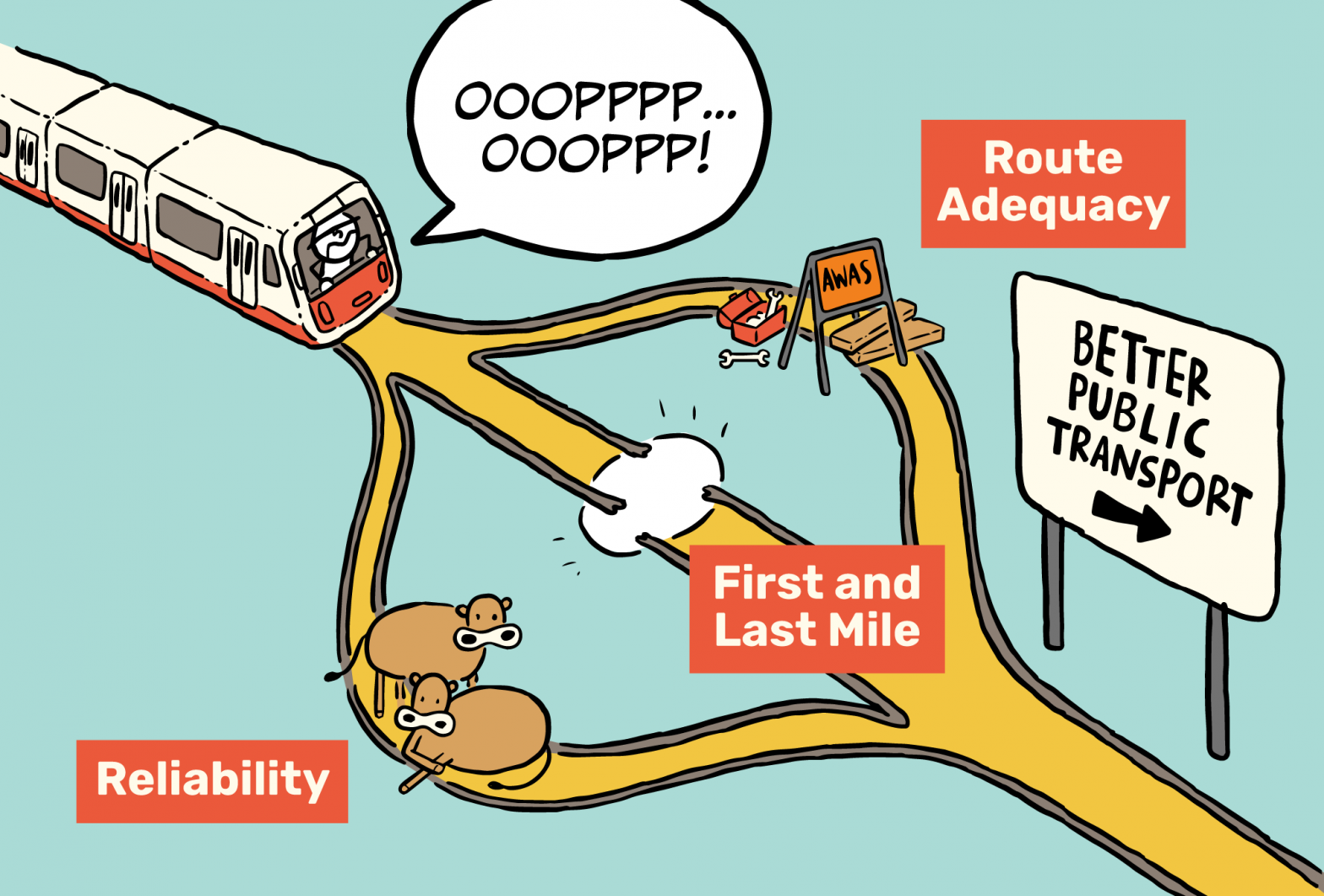
  • A note on methodology: this is not a quantitative study and does not claim to represent the exact size or prevalence of the issues. However, based on the overlap between interview responses, personal experience and literature research (including social media posts), we conclude that there are three major sources of costs and frictions to resolve: first mile-last mile connectivity, service reliability and route adequacy.
  • These issues have been discussed elsewhere, but in this piece we take stock of current thinking and advance some policy initiatives towards achieving some minimum standards in public transport commuting.

1. First Mile-Last Mile Connectivity

  • First mile-last mile connectivity here refers to the mode of transport or connection to reach the closest metro-rail station. To make full use of the multi-billion ringgit investments in the LRT, MRT and KTM networks, the trip to the nearest or most practical metro-rail station needs to be affordable and relatively short. Yet, many commuters do not have proper access to affordable first mile-last mile solutions; either their areas are underserved or available services are infrequent and unreliable.
  • First mile-last mile connections are typically buses, e-hailing services and taxis. Cycling and walking also fall under this category if you live close enough to the station.
  • Feeder buses are the main service providers for first mile-last mile connections though e-hailing services are increasingly used as a solution as well. However, according to SPAD (the precursor to APAD), the feeder bus system face limited resources, which affects frequency and route coverage.

Current Direction

  • The Minister of Transportation Anthony Loke has stated that the government will collaborate with local councils, feeder bus operators and e-hailing services to resolve the first mile-last mile connection issue though to date no specific measures has been announced. RapidKL however, recently announced implementing a trial run of minibuses to cover areas not reachable by its larger vehicles.
  • Meanwhile, the Finance Minister’s political secretary Tony Pua has mentioned that Putrajaya is currently in talks with e-hailing service Grab to provide first-mile connection.
  • One key approach towards resolving first mile-last mile connectivity appears to be Transit-Oriented Development (TOD) i.e. encouraging mixed commercial and residential development along existing or future MRT stations. Whereas this is good for new areas, mature areas will still need solutions that work with the way the neighbourhood is laid out.

“Why should you provide feeder buses if you can work with Grab? They can actually arrive and give door-to-door delivery from the MRT to commuters’ homes at a reasonable price, and at a cost that will be cheaper than us (the government) supplying feeder buses.”

Tony Pua, Political Secretary to the Minister of Finance

  • E-hailing as a solution for first mile-last mile connectivity might relieve costs for the government, but there is no guarantee that it would be affordable for lower income commuters unless there is some cost-sharing. Adding to the issue is the uncertainty in e-hailing prices and driver availability with the full implementation of the PSV license by 12 October this year, after the deadline was extended by the Ministry of Transportation.
  • Interestingly, a small town in Canada had piloted e-hailing as a solution to public transportation problems. The experience of Innisfil shows some of the issues that arose from the pilot, including the higher cost of subsidising ride-sharing services compared to establishing feeder bus services.

Policy Considerations

  • What might be decent standards in the case of first mile-last mile connectivity? A 2018 Penang study showed that commuters were willing to walk for around 13 minutes or 600 metres to reach the closest bus station if walkway conditions were safe and accessible. Given this, perhaps we should aim for having the nearest public transport point, such as a bus stop, to be no more than a 15 minutes’ safe walk away from a person’s home.
  • What about the trip from the bus stop to the next destination, say the LRT or MRT station? Good public transportation for this leg should be reliable and affordable. But if the feeder bus system is limited by budgetary resources, as maintained by the authorities, what can be done to deliver these first mile-last mile needs?

Share first mile-last mile demand data

  • What if commuters could indicate their first mile-last mile needs and ride-share scheduled vehicles with other commuters? This was the premise of initiatives such as Beeline and GrabShuttle in Singapore as well as Uber Bus in select cities in Egypt. In 2017, a similar carpooling pilot, called GrabShare was tested in Malaysia though the service has since been put on hold for improvement purposes. This is similar to another Malaysian carpooling initiative, Tumpang which was launched in 2015 but has since gone defunct.
  • Throughout cities in the United States, commuting platforms are allowing communities to take part in first mile-last mile crowdsourcing where people submit route suggestions, drop-off points and schedules. Enough votes for a route or schedule would confirm and charter the service.
  • Since first mile-last mile connectivity is needed to increase usage of public transport, we take the position that providing first mile-last mile demand data is a public good and should be funded (or otherwise facilitated) by the government. The data would provide feeder bus companies better insight into high-demand routes and times, reducing the problem of empty buses and wasted resources. The data would also provide valuable information to other types of transport services, who could then compete to ply those routes.

Enable a range of innovative service providers

  • Not all routes or housing areas can be serviced by large feeder buses. And not all routes can satisfy both demand and profits, such as in low-income areas. Giving access to first mile-last mile demand data is a needed step, but subsidising and facilitating different types of solutions is also needed particularly for community-driven initiatives. The RM500 million public transport adoption fund set up by the government could be used to pilot such community-driven initiatives wherever needed, allowing solutions to surface from the ground up.

2. Reliability

  • The unreliability of both feeder bus and KTM services are often mentioned in studies and surveys on Malaysian public transportation. A study on Putrajaya bus services, for example, showed that many commuters faced infrequent service, lack of punctuality and lack of information on routes or schedules.
  • A similar issue plagues the KTM, as shown by this study investigating the railway service. The KTM also has appears to have communication issues; commuters are frequently not informed of delays and disruptions ahead of time, with no replacement or alternative services offered.


L, 32, stays in Rawang. For L, the feeder buses would often come at unpredictable times and would sometimes reduce service frequency without warning commuters beforehand. It is L’s only mode of transportation to work, as the bus company is the only public transport mode servicing L’s area.


AS, 29, leaves home early to catch a specific KTM train that goes directly to his workplace. Due to current upgrading works, the service frequency is been reduced to once per hour. If a disruption or delay happens, AS is forced to take the infrequent replacement buses and connecting train lines which takes far longer.

  • KTMB’s unreliability may stem from years of poor financial performance and a problematic business model. But there also appears to be a lack of accountability for shortfalls in reliability within the various public transportation institutions. For example, on-time performance amongst the various public transport services are not routinely published, nor does it appear to impact budgetary or hiring decisions.

Current Direction

  • As far as accountability goes, in 2018 Prasarana was directed to announce delays above 15 minutes under a new standard operating procedure.

“All delays involving technical problems in excess of 15 minutes are categorised as ‘major disruption’ and the onus is on Prasarana to provide clarification to the public through a media conference.”

Anthony Loke, Minister of Transportation

  • Currently, this requirement only extends to the Rapid KL LRT service. The focus is on services provided by Prasarana and not yet for problematic rail services such as the KTM. In 2011, KTM announced that they would refund journeys delayed over 30 minutes. Despite the policy, there is no information on their site, indicating how to engage in this process. This is unlike RapidKL which provides accessible information showing commuters how to seek refunds in cases of delays.

Policy Considerations

  • What might be decent standards in the case of public transport reliability? For a significant number of city dwellers who’ve used e-hailing services such as Grab, it is difficult to accept any other standards. This includes relatively consistent frequency of service (for example, a vehicle every 10-15 minutes), real time knowledge of the vehicle’s location as well as relatively on-time arrivals.
  • Technology does not appear to be the constraint; financial and operational effectiveness is likely the crux of the issue. And the spur to achieve better levels of financial and operational effectiveness requires greater transparency, particularly information on service reliability.
  • To this end, we advocate making scoreboards of transport services’ performance public and open-source. Sites such as Recent Train Times, for example, uses open data to predict and score train punctuality of UK rail services, allowing commuters to know which train services are typically late or on time.
  • Making reliability data public would motivate and pressure the various service providers to improve; it would also help to support any government budgetary or investment decisions. This data could also enable independent parties to integrate, utilise and develop the data for useful public-serving applications.

3. Route Adequacy

  • Many of the individuals interviewed for this study shared their experience of long commutes and stress caused by multiple transit connections. For those with no other choice, taking multiple modes of transport and having multiple waiting times to complete one journey is just a fact of life. For some, the journey eventually becomes unbearable, compelling them to move closer to public transport stations despite paying more in housing costs. For others, the lack of a direct route, even for relatively short distances, leads them to choose more expensive options such as e-hailing services.


A, 24, used to stay in Subang and commuted to work by Bus Rapid Transit (BRT) and two LRT lines, to get to work in KL. This journey of three exchanges would take 1.5 hours each way. This commute forced her to find a property closer to KL despite the higher cost.


N, 44, lives in Bangsar and works in Mont Kiara which is a fairly popular car route. However, N would need to take two buses to complete this short 7km journey. On most days, N takes a Grab in to work.

  • The number of transit points is a major source of friction or inconvenience for commuters. Better routes, with minimal transit changes, would encourage people to switch to public transportation as it would decrease the stress of commuting.

Current Direction

  • So far, there doesn’t appear to be any specific developments regarding the improvement of routes and reducing multiple transit connections.    

Policy Considerations

  • What might be decent standards for route adequacy and the number of transit changes? Defining decent standards here is more complex considering the sheer variety of starting points and destinations demanded by commuters, to be balanced against cost-to-service considerations. But the bottom line is, community consultation and involvement in route planning needs to be strengthened in order to make public transportation an attractive option.
  • Much like the first mile-last mile connectivity issue, community involvement to improve route planning can be facilitated by sharing transport demand data. The use of technology and digital tools to resolve commuting or urban planning issues is extremely low for a city with Kuala Lumpur’s population density and GDP – this needs to change.
  • Looking outside Malaysia, platforms like Remix enable urban transportation planners to visualise, calculate and plan transportation networks in and between respective areas. When combined with crowdsourced information, these tools can enable routes that are more tailored to the various needs of the community.

Conclusion

  • Switching from driving to public transportation is the most feasible way to manage transportation costs long-term but only if all the associated hassles and frictions are addressed. To get there, we need to have a set of standards for the public transport commuting experience, one that would encourage the majority of commuters to switch to public transportation.
  • The need for these standards becomes more critical as affordable housing moves further and further away from the city centre. A study of Chinese commuters showed that 45 minutes is a tipping point; those with commutes exceeding 45 minutes prefer shortening their journey by moving while those with commutes under 45 minutes are willing to increase travel times for better jobs or homes.
  • For many commuters in the Klang Valley however, particularly low-income households, moving to reduce commuting time may not be an option. Making commuting via public transport tolerable, if not enjoyable, should be a priority for any government committed to equitability as well as environmental impact.
  • Based on existing research and interviews with commuters, we propose a set of standards for commuting via public transportation in the Klang Valley. This proposed set is meant to provide an initial framework for public discussion; we hope that further studies and pilot projects will provide more representative numbers and supporting details.
  • Our main policy recommendations centre around harnessing technology and public participation by crowdsourcing demand data. This requires the government to take on a more facilitating role rather than a command role in designing and providing public transportation services.
  • By providing a commuting data platform that involves the public more actively, better local-based solutions will emerge. Progressively, we may become a public transport nation after all.

Note: The now-defunct Land Public Transport Agency (SPAD) website previously held useful resources on transportation in Malaysia. The newly-rebranded APAD website have yet to provide a public archive of these resources; we hope that these resources will be made available in the near future for the public interest.

Other interesting reading:

Commuting Calculator (Ford)
Resolving KL’s traffic woes (Edgeprop.my)
Five reasons why public transportation in Malaysia is more expensive compared to Singapore (Ong Kian Ming)
Improving urban transportation for upward social mobility in Malaysia (World Bank)
Integration is the key (The Star)
Taking the nation to the next level (Focus Malaysia)


Email us your views or suggestions at editorial@centre.my.
Hello dan Salam Sejahtera!

Hello Semua!

  • Setelah beberapa bulan bekerja di belakang tabir, dengan rasminya, kami sudah online! Selamat datang ke The Centre.
  • Sedikit imbasan kembali kepada pos pengasas kami tempoh hari: kami adalah kumpulan pemikir dan pusat penyelidikan tidak berpihak (non-partisan) yang membawa penulisan dan kajian tentang isu-isu terkini dengan lensa haluan tengah. 
  • Apakah itu ‘haluan tengah?’ Kami ada terangkannya sedikit sebanyak di sini. Di halaman yang sama, kami juga menyatakan matlamat kami untuk menghasilkan penyelidikan dan penulisan tentang dasar yang lebih mudah dihadam dan ‘sosial’ untuk semua, termasuklah memperbanyakkan bahan dalam Bahasa Malaysia.
  • Selain itu, kami juga mula meneroka beberapa isu dalam topik-topik yang akan diperkembangkan lagi di masa hadapan. Antaranya, di bawah topik reformasi undang-undang, kami menyoroti latar belakang dan perkembangan terkini mengenai hukuman mati di Malaysia sebagai pengenalan kepada persoalan yang sukar dalam usaha Kerajaan untuk meminda undang-undang yang berkaitan. Kami juga ingin membuka topik pengurusan ekonomi negara dan sebagai wadah permulaan, kami membawa primer tentang hutang negara dan editorial tentang bagaimana kita boleh mencorakkan satu wawasan negara bagi menangani masa depan yang agak bergelora. 
  • Kami masih lagi di fasa permulaan dan tentunya The Centre akan melalui evolusinya tersendiri dalam usaha mencari tapak dalam lanskap think tank Malaysia. Kami berharap anda semua dapat bersama-sama kami dalam perjalanan ini. Berikanlah maklumbalas serta idea anda, walaupun sekadar berkongsi cerita dan pengalaman. Jemputlah untuk mendaftar dengan kami bagi menerima maklumat terkini. Selain dari laman web kami www.centre.my, anda juga boleh bersama kami di media sosial: Instagram (centremy_), Twitter (@CentreMY_) dan Facebook (TheCentreMY). Jumpa di sana!
  • Jom, kita mulakan bersama-sama!


Hello Everyone!

  • After a few months of set-up work, we’re happy to say welcome to The Centre!
  • A quick recap of an earlier posting from The Centre’s founders: we are a non-partisan research think tank aiming to bring you writing and research about issues that matter from a centrist point of view.
  • What is a centrist point of view in the Malaysian context? We’ve described what this entails in our ‘About’ page. There, we also state our goal of making policy-relevant writing and research more digestible and ‘social’ to the Malaysian public, including having more Bahasa Malaysia content.
  • Apart from this focus area, we are selectively exploring other topics with the intent of developing them into focus areas in the future. Under legal reform, we start with a primer on the death penalty in Malaysia as an introduction to a complex issue facing the Government and nation, with a potential legal amendment on the horizon. We also aim to cover issues related to the country’s economic management, starting with a simple primer on the national debt as well as an editorial on how as a vision-hungry nation, we could craft a better vision for these turbulent times.
  • It’s still early days for us and we expect to evolve quite a lot as we find our footing in the Malaysian think tank landscape. We hope you’ll join our journey and help us improve with feedback, ideas, or even by just sharing your stories. Do sign up for our site updates. Other than our site www.centre.my, you can find us on Instagram (centremy_), Twitter (@CentreMY_) and Facebook (TheCentreMY). Looking forward to seeing you there.
  • Let’s get (officially) started!

Gaji Minima & Gaji Wajar

Apakah gaji minima dan gaji wajar?


Gaji Minima

  • Gaji minima adalah gaji paling rendah yang boleh dibayar kepada pekerja sepenuh masa mengikut undang-undang. Gaji minima ditetapkan melalui beberapa akta termasuk Akta Majlis Perundingan Gaji Negara 2011, Perintah Gaji Minimum 2012 dan Akta Kerja 1955.
  • Kadar gaji minima dikaji dan dibincang oleh Majlis Perundingan Gaji Negara yang dianggotai oleh wakil kerajaan, majikan, pekerja dan anggota lain. Selepas rundingan antara anggota, Majlis ini mengesyorkan kadar gaji minima kepada Kementerian Sumber Manusia. Jika dipersetujui, kadar tersebut diwartakan untuk perlaksanaan.


Gaji Kehidupan Wajar

  • Gaji kehidupan wajar, atau ‘living wage’, lebih merupakan suatu aspirasi, iaitu kadar gaji minima yang patut dibayar untuk membolehkan seseorang untuk bukan sahaja memenuhi keperluan asas tetapi boleh menjalankan kehidupan yang wajar dan bermaruah, dan tidak dikekang bebanan kewangan yang serius. Rata-ratanya mereka yang menyokong gaji kehidupan wajar mengesyorkan bahawa selain keperluan asas seperti makanan dan tempat tinggal, keperluan lain seperti kos kesihatan, pengangkutan dan juga tampungan kecemasan harus diambil kira juga.
  • Kebanyakan negara mempunyai undang-undang yang mensyaratkan gaji minima, tetapi pelaksanaan gaji kehidupan wajar setakat ini lebih tertakluk atas budi bicara pihak majikan. Organisasi seperti Living Wage Foundation di United Kingdom dan Asia Floor Wage di Asia ada melancarkan kempen-kempen gaji kehidupan wajar dan mencadangkan kadar yang sesuai bagi pertimbangan majikan. Namun, mereka tidak mempunyai kuasa dari segi undang-undang untuk memastikan semua majikan membayar gaji kehidupan wajar.

Mengapa isu ini penting?

  • Gaji minima pada asalnya dilaksanakan untuk mengelakkan eksploitasi pekerja. Dengan penilaian semula konsep ‘pembangunan’ dan ‘mutu kehidupan’ di kalangan organisasi antarabangsa seperti Pertubuhan Bangsa-Bangsa Bersatu, asas dasar gaji minima kian dibahas dan diteliti semula. Pertanyaan pokok mengenai gaji minima hari ini ialah: apakah sebenarnya tujuan gaji minima dan bagaimanakah harus ia ditetapkan?
  • Jika tujuan gaji minima adalah untuk menampung keperluan paling asas kehidupan, erti ‘keperluan asas’ dalam era hari ini perlu dibincang dan ditetapkan*. Jika tujuan gaji minima adalah untuk membolehkan pekerja menikmati mutu kehidupan yang bermakna atau bermaruah, seperti yang dicadang penyokong gaji kehidupan wajar, erti ‘kehidupan bermakna’ juga harus dibahaskan. 
  • Sudah pasti, kedua-dua konsep ‘keperluan asas’ dan ‘kehidupan bermakna’ adalah subjektif; apa ertinya pada saya mungkin tidak sama dengan ertinya pada anda. Tetapi kata sepakat tentang isu ini boleh dan perlu diusahakan. 

*Respons kepada Belanjawanku menunjukkan keperluan untuk mencari persetujuan tentang isu ini.

Apakah kedudukan dan pandangan utama tentang isu ini?

  • Namun begitu, cadangan menetapkan gaji mengikut sektor mungkin tidak memadai kerana ia mengabaikan kadar kos kehidupan mengikut tempat. Perbelanjaan seperti kos makanan, sewa dan cukai pintu berbeza mengikut tempat, jadi penyelesaian mungkin terletak dalam menetapkan gaji minima mengikut sektor dan juga kawasan. 
  • Dari sudut pekerja pula, kenaikan gaji minimum sebanyak RM100 ini tidak memadai. Walaupun Kongres Kesatuan Sekerja Malaysia (MTUC) menyambut kenaikan itu sebagai langkah positif, mereka berasa amaun tersebut masih di takuk yang terlalu rendah. 

Soalan rakyat dan peminat dasar

Apakah sebenarnya tujuan gaji minima dan bagaimanakah harus ia ditetapkan?

Kalau gaji minima tidak dapat dinaikkan ke tahap gaji kehidupan wajar kerana isu keuntungan perniagaan dan sebagainya, apakah peranan Kerajaan? Patutkah penetapan kadar Bantuan Sara Hidup diteliti semula?

Meskipun tahap kemahiran kian meningkat, tidak semua pekerjaan akan bergaji besar. Oleh itu, patutkah gaji minima ditetapkan berdasarkan produktiviti?

Mengapa graduan sahaja patut mendapat gaji kehidupan wajar?

Setakat manakah penggunaan pekerja asing yang dibayar gaji murah mempengaruhi pola gaji negara dan tahap gaji minima?


Email us your views or suggestions at editorial@centre.my.

Mengukur Kos Sara Hidup

Bagaimana kos sara hidup diukur hari ini?

  • Kos sara hidup, dalam bahasa mudahnya, adalah jumlah wang yang diperlukan untuk mengekalkan suatu taraf kehidupan.
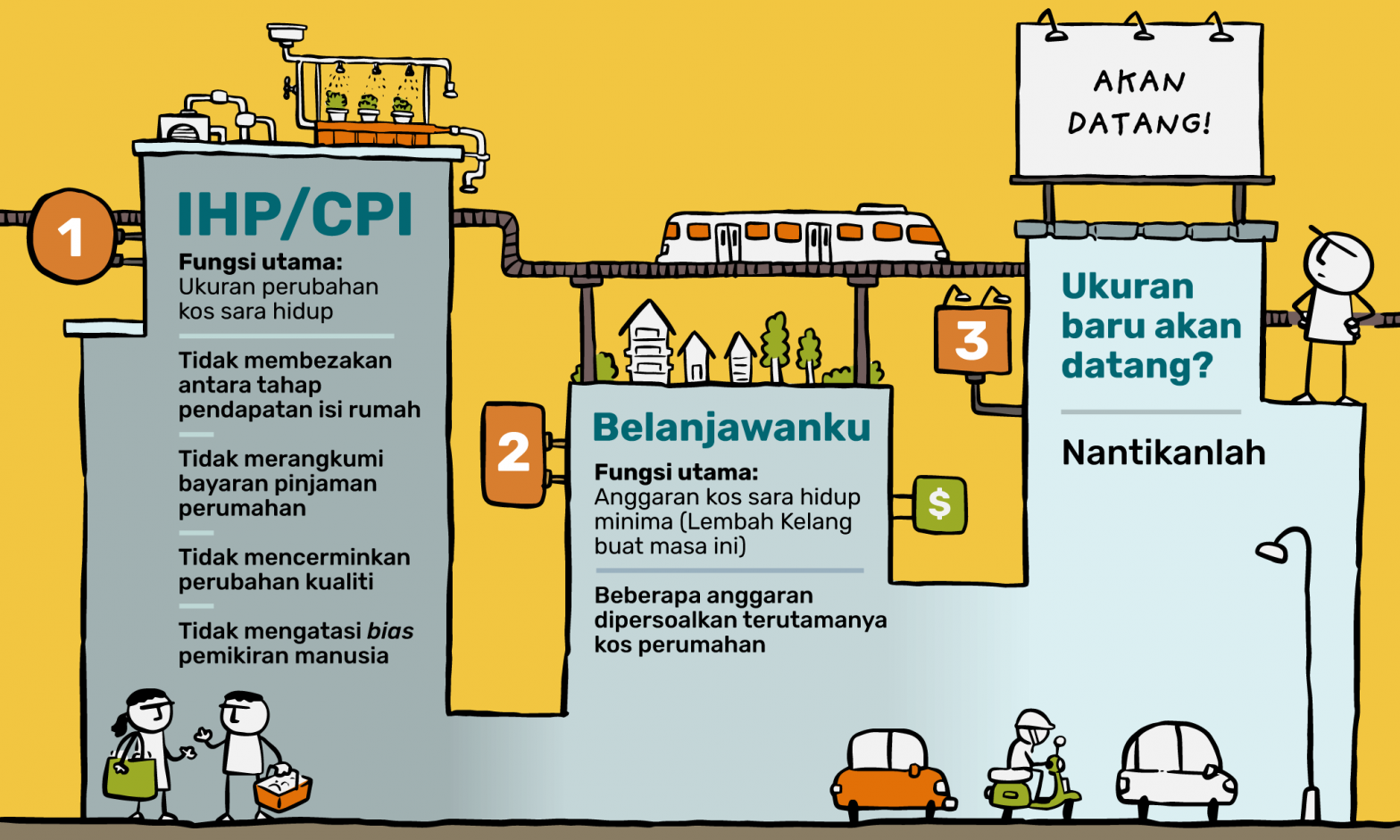
  • Buat masa ini, Indeks Harga Pengguna (IHP, atau singkatan Bahasa Inggerisnya CPI) masih lagi merupakan indikator utama dalam mengukur kos sara hidup.
  • IHP mengukur perubahan harga ‘bakul’ barangan dan perkhidmatan yang dianggap biasa dibeli dan digunakan oleh suatu isi rumah di Malaysia. Terdapat 12 kategori barangan atau perkhidmatan di dalam ‘bakul’ tersebut.
  • Kategori-kategori ini berpandukan ‘Klasifikasi Penggunaan Individu Mengikut Tujuan’ yang dikeluarkan oleh Pertubuhan Bangsa-Bangsa Bersatu.
  • Wajaran (weightage) antara 12 kategori barangan dan perkhidmatan di dalam ‘bakul’ IHP ini diperolehi daripada Tinjauan Penyiasatan Perbelanjaan Isi Rumah (HES) yang dilaksanakan oleh Jabatan Perangkaan Malaysia dari masa ke semasa.
Pameran A: Komposisi dan wajaran IHP. Sumber: Laporan IHP Bulanan*, Jabatan Perangkaan Malaysia

*Nota Teknikal Laporan Penuh IHP Bulanan terbitan Jabatan Perangkaan Malaysia. Pendaftaran menerusi portal Jabatan Perangkaan Malaysia diperlukan untuk mengakses laporan.

  • Bagi mengukur IHP, Jabatan Perangkaan Malaysia membuat tinjauan harga barangan dan perkhidmatan setiap bulan atas kira-kira 17,000 kedai di Semenanjung Malaysia, 2,500 kedai di Sabah dan 2,300 kedai di Sarawak.
  • Perlu diingati, fungsi utama IHP adalah mengukur perubahan kos sara hidup dari bulan ke bulan atau tahun ke tahun. Ianya diungkap dalam bentuk peratus (%) dan bukan jumlah nyata RM. 

Apa masalah IHP?

  • Menggunakan IHP sebagai ukuran utama kos sara hidup mungkin mengelirukan. Seperti yang dinyatakan di atas, IHP lebih kepada pengukuran kadar perubahan harga, iaitu pengukuran inflasi. Dalam pada itu, masih terdapat beberapa isu tentang IHP yang perlu diberi perhatian.
  • Pertama, walaupun IHP cuba membezakan kadar perubahan harga antara negeri dan kategori perbelanjaan (sebagai contoh, lihat laporan CPI bagi April 2019), IHP tidak menggambarkan kadar perubahan harga atau inflasi bagi isi rumah dari tahap pendapatan yang berbeza. Dan sudah tentunya, isi rumah dari tahap pendapatan, malah lokasi, yang berbeza akan mengalami tahap inflasi yang berbeza.
  • Laporan Tahunan Bank Negara Malaysia (BNM) 2015 menunjukkan bahawa isi rumah yang berpendapatan lebih rendah pada amnya mengalami kadar inflasi yang lebih tinggi. Isi rumah berpendapatan rendah di kawasan bandar juga cenderung untuk mengalami inflasi lebih tinggi daripada isi rumah pendapatan rendah yang tinggal di luar bandar.
Pameran B: Inflasi mengikut kumpulan pendapatan, negeri & kawasan. Sumber: Laporan Tahunan BNM 2015
  • Kedua, bayaran pinjaman rumah tidak termasuk dalam ‘bakul’ IHP; cuma sewa rumah diambilkira. Menurut pakar ekonomi (contohnya, sumber ini), mengabaikan bayaran pinjaman rumah akan membuatkan IHP terlalu rendah, lebih-lebih lagi memandangkan peningkatan harga rumah yang sangat pantas berbanding dengan kadar harga lain.
  • Ketiga, IHP hanya mengukur pergerakan harga tetapi tidak mengambilkira faktor kualiti. Jika harga meningkat tetapi kualiti barangan dan perkhidmatan menurun, kos sara hidup kita boleh dikatakan lebih buruk berbanding kadar inflasi. Sebaliknya, jika kualiti bertambah baik selari dengan kenaikan harga, kos sara hidup boleh dikatakan menjadi lebih baik. Tentunya, perubahan kualiti tidak senang diukur namun faktor ini harus juga dipertimbangkan.
  • Keempat, bias atau kecenderungan psikologi kita. Sebagai manusia, kita seringkali membuat kesimpulan berdasarkan maklumat yang terhad. Kajian menunjukkan bahawa pengguna cenderung merasakan dan mengingati kenaikan harga berbanding penurunan harga. Oleh itu, rasa ‘tidak setuju’ dengan kadar inflasi IHP yang dilaporkan sedikit sebanyak disebabkan faktor kecenderungan psikologi ini.

Apakah perkembangan terkini

  • Kayu pengukur kos sara hidup yang tepat dan yang diterima rakyat adalah penting, bukan sahaja bagi kegunaan dasar gaji dan dasar lain, tetapi juga bagi menunjukkan kedudukan sebenar kos kehidupan rakyat. Panduan Belanjawanku yang diterbitkan pada Mac 2019 menerusi kerjasama KWSP dan Pusat Penyelidikan Kesejahteraan Sosial (SWRC) Universiti Malaya merupakan suatu langkah ke arah matlamat ini.
  • Panduan Belanjawanku dilapor sebagai berdasar kepada pola perbelanjaan sebenar enam jenis isi rumah di Lembah Klang, dari kategori bujang sehinggalah pasangan warga emas. Namun begitu, telah timbul beberapa persoalan tentang Belanjawanku terutamanya mengenai kos tempat tinggal, dengan ada yang mengatakan ia tidak menggambarkan realiti Lembah Kelang.

Baca cadangan kami bagi memperkukuhkan usaha Belanjawanku.

  • Selain daripada itu, Menteri Perdagangan Dalam Negeri dan Hal Ehwal Pengguna (KPDNHEP) juga telah mengumumkan sebuah indeks kos sara hidup baru bagi mencerminkan keadaan sebenar. Antara agensi-agensi yang dikatakan terlibat di dalam pembentukan indeks baru ini ialah Jabatan Perangkaan Malaysia, Institut Penyelidikan Khazanah (KRI) dan Suruhanjaya Persaingan Malaysia (MyCC).

Tertanya-tanya tentang harga nasi lemak atau epal di tempat-tempat lain di Malaysia? Lihat lampiran kepada laporan IHP bulanan

Beberapa persoalan peminat dasar serta rakyat biasa:

Bagaimanakah tahap ‘minima’ kos sara hidup ditentukan? Bagaimanakah kualiti mutu kehidupan, barangan dan perkhidmatan diambilkira dalam ketentuan ini?

Bagi mendapatkan gambaran yang lebih jelas tentang isi rumah yang berbeza, terutamanya bagi yang berpendapatan rendah, bagaimana kalau diwujudkan ukuran kos sara hidup mengikut kumpulan pendapatan dan lokasi?


Sumber-sumber lain:

Inflation and the Cost of Living (BNM)
Cost of Living in Malaysia, crowdsourced (Numbeo)
Malaysia House Price Index (Trading Economics)
Malaysia Food Inflation (Trading Economics)


Email us your views or suggestions at editorial@centre.my.

Jumlah Hutang Negara – Angka Mana Yang Benar?

Berapakah sebenarnya jumlah hutang negara?

  • Latar belakang: Sejurus selepas mengambil alih pentadbiran Kerajaan Persekutuan, Pakatan Harapan mengumumkan bahawa hutang negara telah mencecah RM1 trilion.  Tetapi data rasmi terbitan Bank Negara pada masa yang terdekat pada ketika itu, iaitu suku pertama 2018, menunjukkan bahawa hutang negara berjumlah RM705 bilion. (Angka ini meningkat kepada RM741 bilion pada suku keempat 2018). Disebabkan percanggahan ini, jumlah hutang negara menjadi perdebatan hangat di Dewan Rakyat. 
  • Hakikatnya, kedua-dua angka tersebut adalah angka yang benar. Angka yang mana dipilih untuk mewakili jumlah hutang negara sebenarnya berkait rapat dengan tatacara atau standard perakaunan yang diguna pakai.
  • Di bawah pentadbiran enam Perdana Menteri lalu, Kerajaan Persekutuan mengguna pakai standard perakaunan asas tunai, satu kaedah yang merekod sesuatu urusniaga apabila tunai diterima atau dibayar dalam sesuatu tempoh perakaunan*.
  • Di bawah standard perakaunan asas tunai, hanya hutang-hutang rasmi langsung yang diterbitkan atas nama kerajaan sahaja, seperti bon dan bil perbendaharaan, perlu dinyatakan dan diambil kira di dalam penyata kewangan kerajaan.
  • Standard perakaunan asas tunai inilah yang digunakan oleh Bank Negara untuk mengeluarkan data rasmi berkenaan jumlah hutang negara. Di bawah asas tunai, jumlah hutang negara pada akhir 2017 adalah RM686.8 bilion, RM705 bilion pada suku pertama 2018 manakala pada akhir 2018 adalah berjumlah RM741 bilion.

*Nota: Untuk mengetahui lebih lanjut tentang standard perakaunan tunai, sila layari Government Finance Statistics (GFS 1986) yang dikeluarkan oleh International Monetary Fund (IMF), dan Financial Reporting under the Cash Basis of Accounting yang dikeluarkan oleh International Public Sector Accounting Standard (IPSAS).

Bagaimana hutang negara boleh menjadi RM1 trilion dari RM705 bilion?

Angka-angka ini merujuk kepada suku pertama 2018
  • Ketika Menteri Kewangan mengumumkan jumlah hutang negara sebagai RM 1 trilion pada 25 Mei 2018, Menteri Kewangan turut mengambil kira liabiliti-liabiliti Kerajaan yang lain seperti jaminan Kerajaan komited (committed government guarantees) dan juga bayaran pajakan (lease payments) kepada pihak swasta untuk projek-projek awam di bawah model kerjasama awam-swasta PPP (Public Private Partnership) dan PFI (Private Finance Initiative)
  • Jaminan Kerajaan komited adalah jaminan yang diberi atas hutang terbitan syarikat berkait Kerajaan atau Special Purpose Vehicles (SPV) untuk pelaksanaan projek-projek awam tertentu. Bayaran pajakan pula adalah bayaran berkala kepada pihak swasta yang telah melaksana dan membiayai pelbagai jenis pembangunan awam seperti sekolah, hospital, universiti dan lain-lain bagi pihak Kerajaan.
  • Standard perakaunan asas tunai yang diguna pakai selama ini menetapkan bahawa kesemua jaminan Kerajaan komited dan bayaran pajakan hanya perlu direkodkan di dalam memorandum berasingan dan tidak dimasukkan dalam jumlah hutang rasmi negara. Angka-angka ini sememangnya terdapat di dalam penyata kewangan yang dikeluarkan oleh Kerajaan pada tahun-tahun lalu seperti mana yang ditetapkan di bawah standard GFS 1986. 
  • Punca perbezaan antara pelaporan tahun-tahun lalu dan pengumuman Menteri Kewangan adalah dalam penukaran standard perakaunan kepada tatacara yang lebih baru berdasarkan ​GFS 2014 dan juga IPSAS ​yang dikeluarkan oleh ​International Federation of Accountants (IFAC)​.
  • GFS 2014 dan IPSAS ini menggunakan ​asas akruan yang mengharuskan ​pelaporan dalam satu tempat semua urusniaga semasa dan apa-apa bayaran yang perlu ditanggung kerajaan pada masa hadapan. 
  • Menerusi asas akruan ini, kerajaan perlu menyediakan lembaran imbangan yang menunjukkan segala bentuk aset dan liabiliti kerajaan. Berbeza daripada asas tunai, ini bermakna jaminan Kerajaan komited dan bayaran pajakan perlu ditempatkan bersama hutang langsung Kerajaan dan bukan lagi dilaporkan menerusi memorandum berasingan. 
  • Oleh kerana perbezaan dalam tatacara perakaunan dan pelaporan ini, angka jumlah hutang negara boleh beralih daripada sekitar RM700 bilion kepada RM1 trilion. Tetapi pada dasarnya, jumlah tanggungan Kerajaan tidak berbeza.
  • Sehingga Disember 2018, liabiliti Kerajaan Persekutuan menurut asas akruan adalah berjumlah RM1 trilion dan merangkumi:
    • Hutang langsung kerajaan sebanyak RM741 bilion
    • Jaminan Kerajaan komited sebanyak RM133 bilion
    • Jumlah bayaran pajakan untuk projek PPP-PFI dan lain-lain liabiliti sebanyak RM217 bilion

Bilakah keputusan untuk menukar standard perakaunan Kerajaan diambil?

  • Keputusan perpindahan standard perakaunan dari asas tunai kepada asas akruan dibuat Kerajaan di bawah BN selepas mengambil saranan dari badan dunia IMF dan Bank Dunia. Asas akruan dikatakan lebih transparen dan memberi gambaran sebenar kedudukan kewangan dan jumlah tanggungan sesebuah negara.
  • Peralihan tersebut dipersetujui oleh Kerajaan Persekutuan pada tahun ​2011 selepas mengambil kira cadangan yang dikeluarkan oleh Public Finance Reform Lab ​di bawah ​Strategic Reform Initiatives​ kelolaan PEMANDU. 
  • Menerusi ​Rancangan Malaysia Kesebelas (RMK-11) Kerajaan Persekutuan juga menyatakan bahawa sistem akruan akan dilaksanakan secara berperingkat bagi semua laporan perakaunan sektor awam dan bahawa pelaksanaan penuh sistem akruan akan dicapai pada tahun 2021. 
  • Namun begitu, perlu diingatkan bahawa sama ada asas tunai atau asas akruan, kedua-dua standard ini masih diperakui dan diterima piawaiannya di peringkat antarabangsa. 

Tahukah Anda?
Kerajaan Persekutuan terikat dengan undang-undang yang menghadkan jumlah hutang terbitan kerajaan: 55% daripada KDNK bagi hutang domestik, RM35 bilion untuk pinjaman luar persisir dan RM10 bilion bagi bil perbendaharaan.

Antara soalan rakyat dan peminat dasar:

Apakah angka hutang negara di bawah kedua-dua asas tunai dan asas akruan untuk tahun-tahun lalu? Apakah trend yang boleh dilihat?

Patutkah kita sebagai rakyat dan pengundi bimbang tentang jaminan Kerajaan dan bayaran pajakan? Apakah kelebihan dan kelemahan jenis-jenis tanggungan ini?

Apakah tahap hutang negara yang sihat?

Perbezaan dalam angka hutang negara yang dilaporkan senang dijadikan bahan politik. Adakah wujud apa-apa peraturan yang mengawal cara maklumat ini diterangkan?


Pautan lain:

Hutang Luar Negeri Malaysia (Bank Negara)
Fakta di sebalik hutang negara (Malaysiakini)


Email us your views or suggestions at editorial@centre.my.

Belanjawanku: Belanjawan Anda?

Isu kos sara hidup yang semakin meningkat berbanding kenaikan gaji adalah keluhan yang sering kita dengar saban hari.

Untuk membantu warga kota, pada Mac tahun ini pihak KWSP bersama Social Wellbeing Research Centre (SWRC) University Malaya menerbitkan panduan perbelanjaan sara hidup bagi individu dan keluarga di Lembah Klang yang diberi nama Belanjawanku. Walaupun niat usaha ini positif, laporan tersebut disambut beberapa persoalan dari orang ramai, terutamanya tentang kewajaran kos-kos yang dipaparkan. 

The Centre berpendapat bahawa usaha Belanjawanku ini berpotensi tinggi menjadi sumber maklumat dan panduan utama bagi rakyat untuk merancang perbelanjaan. Tetapi untuk mencapai potensi ini, ia perlu diterima oleh kumpulan sasarannya. Kami dengan hormat memajukan beberapa cadangan ke arah ini.

Belanjawan Siapa?

  • Pengarah SWRC, Datuk Dr. Norma Mansur, dalam temuramah dengan stesen radio BFM menjelaskan bahawa Belanjawanku merupakan panduan bagi merancang perbelanjaan, bermula dengan warga Lembah Klang. 
  • Menurut laporan, kos-kos perbelanjaan yang disarankan dalam Belanjawanku datang dari data yang sedia ada, tinjauan yang dijalankan pihak SWRC di ibu kota, pemeriksaan harga serta kumpulan tumpuan (focus groups).
  • Namun begitu, maklum balas orang ramai terhadap beberapa kos yang disarankan memberi gambaran bahawa beberapa nasihat Belanjawanku mungkin sukar diikuti, termasuk mereka yang berpendapatan rendah. Kami mengambil kes perbelanjaan sewa rumah sebagai contoh.
  • Panduan perbelanjaan sewa rumah Belanjawanku untuk seorang yang belum berkahwin dan yang tinggal di Kuala Lumpur ialah sebanyak RM300 untuk satu bilik. Untuk mendapatkan kepastian sama ada amaun ini adalah realistik, kami membuat tinjauan ringkas di laman web ibilik.com.
Berdasarkan tinjauan di ibilik.com
  • Kami dapati bahawa di dalam lingkungan 20km dari pusat bandar Kuala Lumpur, sewa bilik adalah dalam sekitar RM450-RM600 di kawasan ‘berpatutan’ seperti Setapak atau Jalan Klang Lama. Untuk bilik yang berharga RM300 perlulah lebih jauh sedikit seperti di Cheras atau Petaling Jaya. 
  • Jika diperluaskan ke kawasan lebih jauh dari pusat bandar tetapi masih dalam lingkungan Lembah Klang seperti Klang, Serdang, Rawang atau Semenyih, maka sewa RM300 ini memang ada. 
  • Menurut kajian laman web iMoney yang dilaporkan oleh the Malay Mail pula, ada anak muda belum berumahtangga yang tinggal di sekitar Lembah Klang dengan kos sewa bilik hampir kepada RM1,100 sebulan. Sudah tentu, ini bukanlah panduan perbelanjaan yang paling minima tetapi ia menunjukkan aspek pertimbangan antara kos, jarak dan mutu bilik yang perlu dibuat.
  • Semakin jauh dari ibu kota, semakin kurangnya pengangkutan awam yang cukup kerap dan boleh dipercayai; apa-apa penjimatan dari segi sewa rumah atau perbelanjaan runcit akan disalurkan balik kepada kos pengangkutan pula.
Sumber: Risalah Panduan Belanjawanku KWSP
  • “Kehidupan bermakna” ini bukan sekadar cukup untuk makan minum, pakaian dan tempat tinggal ala kadar, tetapi dalam keselesaan berpatutan dan boleh membuat perbelanjaan budi bicara lain termasuk menghantar wang kepada ibu bapa atau tanggungan tambahan lain. 

Panduan perbelanjaan paling minima atau panduan perbelanjaan untuk hidup yang bermakna?

Realiti Kehidupan di Ibu Kota

  • Pada masa yang sama, saranan gaji wajar oleh Bank Negara Malaysia (BNM) untuk warga Kuala Lumpur yang belum berkahwin ialah sebanyak RM2,700. (Baca primer kami yang menjelaskan perbezaan antara gaji kehidupan wajar dan gaji minima).
Sumber : Kertas Kerja Gaji Wajar (Bank Negara Malaysia)
  • Jelas, angka yang disarankan oleh Belanjawanku untuk warga Lembah Klang yang belum berkahwin adalah lebih rendah dari gaji kehidupan wajar yang disarankan oleh BNM. Angka yang manakah yang patut dijadikan panduan?
  • Apa pun jua, hakikat kehidupan sebenar warga kota tidak boleh disimpulkan dengan gambaran secara purata. Berikut merupakan sorotan tiga warga Lembah Klang yang begitu berbeza pola kehidupan mereka:

F, 25, belum berkahwin, tinggal di Serendah dan bekerja di Kuala Lumpur
F memilih untuk tinggal bersama keluarga untuk menjimatkan wang dan berulang-aling menggunakan perkhidmatan KTM Komuter. Beliau tiada kos sewa, dan membelanjakan lebih kurang 10% dari gaji beliau untuk kos pergi balik sejauh 85km setiap hari. Gaji beliau sekitar RM2000-RM2500.

A, 24, tinggal di Rawang dan bekerja di Kuala Lumpur
A menyewa kerana tidak berasal dari Kuala Lumpur, jadi dia tidak boleh tinggal di rumah keluarganya. Beliau berulang-alik hampir 70km setiap hari, dan hampir 43% dari gaji beliau dibelanjakan untuk sewa dan kos pengangkutan. Gaji beliau sekitar RM3000-RM3500.

P, 29, tinggal di Semenyih dan bekerja di KLCC
Sebab utama P memilih untuk tinggal di Semenyih adalah faktor keluarga: beliau adalah anak sulung dan tinggal bersama ibu bapa beliau. Ini menjimatkan kos dari segi sewa rumah: jika P menyewa lebih dekat dengan tempat kerja, kos ini akan memakan lebih kurang 25% dari gaji beliau, wang yang katanya lebih elok digunakan untuk menyara keluarga. Beliau berulang alik dengan motosikal dan kereta. Kos perbelanjaan boleh mencapai 20% dari gaji beliau jika berkereta.

  • Apabila kita mengambil kira kesemua ini secara menyeluruh, memang sukar untuk kita membuat hanya satu dasar, atau satu kesimpulan. Ini merupakan cabaran yang dihadapi oleh pihak pentadbiran dan penggubal dasar. Namun begitu, ini tidak bermakna kita tidak boleh berbuat apa-apa. 

Langkah ke hadapan

  • Jadi, ke mana kita sekarang? Kami di The Centre sebenarnya menyambut baik usaha-usaha seperti Belanjawanku, kerana kami percaya bahawa dasar kerajaan perlu selari dengan usaha mendidik rakyat tentang pengurusan kewangan yang lebih mapan. 
  • Yang jelas, kejayaan usaha Belanjawanku sebagai reference budget atau panduan perbelanjaan bergantung kepada penerimaan masyarakat – dan penerimaan ini pula dipengaruhi oleh sejauh mana masyarakat dapat ‘melihat’ diri mereka sendiri dalam saranan yang dibuat. 
  • Oleh itu, kami ingin mencadangkan  dalam versi seterusnya, panduan Belanjawanku ‘dihidupkan’ dengan beberapa contoh individu dan keluarga sebenar yang mewakili kes-kes biasa di Lembah Kelang. Contoh yang khusus, apalagi yang boleh dikaitkan dengan wajah ‘rakyat biasa’ dan maklumat yang relevan, lebih dipercayai daripada sekadar statistik.
  • Kedua, fokuskan sasaran panduan tersebut mengikut lokasi atau jenis penempatan. Panduan belanjawan bagi mereka yang tinggal dan bekerja di Lembah Kelang harus mengetengahkan pelbagai perbezaan; sama ada tinggal dekat dengan pusat bandar atau tidak, berkenderaan sendiri atau tidak dan bermacam lagi. Panduan belanjawan bagi mereka yang tinggal di bandaraya lain, bandar sederhana, pinggir bandar dan luar bandar akan mempunyai ciri-ciri tersendiri.

Akhir kata, untuk renungan:

Dengan bantuan laporan Belanjawanku sebagai reference budget, bagaimanakah kita boleh menggalakkan seseorang individu atau keluarga berbelanja dengan lebih sihat dengan maklumat yang diberikan? Kita tahu bahawa pemberian maklumat semata-mata tidak semestinya akan mengubah tabiat, lebih-lebih lagi apabila perubahan tersebut adalah sukar.

Kami ingin mendengar dari anda: apakah perancangan yang perlu ada untuk menzahirkan apa yang tertera di kertas, kepada perubahan sebenar gaya hidup?


Email us your views or suggestions at editorial@centre.my.

In Search of Vision for Our Times

A vision-hungry nation

  • A year on, one of the biggest criticisms levelled against the PH government is the lack of a compelling economic vision. An April 2019 survey of 250 Malaysian businesses by Ipsos Business Consulting cited uncertainty over government policies and direction as a major concern. Ex-Minister of Finance 2 Johari Abdul Ghani articulated the issue accurately, pointing out the lack of a central economic narrative from the Government.
  • Admittedly, as a nation we appear to like long-term policy statements and sweeping themes for economic growth and societal progress. The New Economic Policy ran for two decades from 1971 to 1990, followed by the 30-year Vision 2020 (1991-2020). Shorter term checkpoints were provided by the 5-year Malaysia Plans (Rancangan Malaysia), a long time in today’s pace of change.
  • On the part of our past leaders and policymakers, this inclination to the long-term perhaps indicates the assumption of continuing rule. Vision-making in countries with higher government turnover usually lasts only as long as the President’s term; for a stark example, see the progressive dismantling of President Obama’s policy legacies by President Trump’s Administration. 
  • Given Malaysia’s break from one-party rule, perhaps shorter-term visions will also be the case for us. In the meantime, on the first-year anniversary of their historic GE win, the PH government appeared to answer critics by announcing a new economic model entitled ‘Shared Prosperity 2030’.
  • Departing from the decades-long sweep of Vision 2020, the model is scoped to last ‘only’ another 11 years into the future. Given the uncertainty of our politics, not to mention the pace of change in the world, this is perhaps not a bad thing for our vision-hungry nation.

But does it satisfy?

  • Departing from the past economic model, which was said to be mainly  about mega projects*, Shared Prosperity 2030 states its overarching premise as achieving a decent standard of living for all Malaysians regardless of income class, race and geographic location.

*Speaking of mega projects…
The term ‘mega projects’ has been a criticism against Government economic management going back to the 1990s. For another reminder of the importance of political memory: a critique of Tun Mahathir’s economic legacy by Professor Jomo Kwame Sundram back in 2003.

  • The new model, as reported by the media, consists of these 7 pillars:
    • better structuring of and improving the nation’s business and industry ecosystems such as via adoption of Industrial Revolution 4.0
    • application of digital economy, and adding more high-skilled jobs
    • exploring new growth sectors, and turning Malaysia from a consumer nation to one that produced more international standard products
    • reforming human capital, to improve labour market and wages
    • strengthening social well-being through needs-based policies
    • inclusive territorial development
    • improving society capital, combined with strong social support mechanisms
  • So far, so…well-trodden. Go through the last few Rancangan Malaysia and you will see virtually the same things couched in different phrasing.
  • To some extent, the emphasis on themes like sharing prosperity and having a decent standard of living is understandable. After 3 bruising by-election losses, there may be a desire within PH to take back the narrative and be seen to respond to grouses
  • Unfortunately for Shared Prosperity 2030 however, two things: (i) in these polarised times, grouses will not be placated by general pronouncements of ‘shared prosperity’ particularly amongst the Malay ground, and (ii) there is still no central economic narrative that can rally and energise the country.

What do we want to be?

  • The latter point is our main criticism: Where is the Vision in Shared Prosperity 2030? After the developed nation status of V2020, what do we want to be?

Where is the Vision in Shared Prosperity 2030? After the developed nation status of V2020, what do we want to be?

  • Ex-PM Najib Tun Razak attempted to supply the next Vision via the campaign ‘Transformasi Nasional 2050’ (TN50), with the aim of having Malaysia become a top 20 nation by 2050. There were clearly some problems regarding scope here – top 20 in what exactly? – but in discussing the notion, it at least became a conversation with ambition.
  • (Not unfettered ambition however, as our room to maneuver is now much more limited. The Malaysian population is ageing. The pace of technological disruption is accelerating (content behind paywall). The climate is changing, with potentially catastrophic consequences.)
  • We never got to narrow down what we wanted to be ‘top 20’ in because GE14 happened and TN50 became an untouchable relic of the previous Administration, along with 1Malaysia and other ‘brands’ (Negaraku, anyone?). 
  • It is a bit of a shame, though. In the rush to tar everything related to the previous Administration, some interesting ideas from the TN50 conversation were summarily erased. One idea in particular could make us think about our economic narrative in a new and more meaningful way.

A meaningful, ambitious Vision

  • What if, instead of aiming to be on the top of some global developmental league table, we as a country aim to be a nation that rises to the challenges and needs of our era? What if we aimed to become a country that solved some of the problems of our times?
  • From such discussions in various youth engagement forums came the notion of moonshot goals as an approach towards national vision-setting. The term ‘moonshot’ memorialises US President John F. Kennedy’s 1961 announcement to put a man on the moon by the end of that decade. At the time of his announcement, no one knew how it was going to be done. Yet, the USA’s first manned voyage to the moon was achieved within eight years of the announced goal.
  • Similarly, the idea was for Malaysia to set several ambitious tasks – goals we may not know how to pull off yet but could progressively figure out, in the process creating new industries and new jobs. And instead of the usual obsession with tallest, biggest, fastest, these moonshot goals for Malaysia should be about solving complex but vital issues. 
  • What sort of moonshot goals? Being a carbon-neutral country by 2050. Being food sufficient and replenishing our fishing stocks by 2030. Less than 10% incidence of lifestyle diseases like diabetes and obesity by 2050. No one living in poverty by 2030, based on an updated and widely accepted definition of ‘poverty’. These were just some of the moonshot goals proposed by people in their teens, 20s and 30s – people who will inherit this country in the coming decades, and who need a worthwhile Vision to see them through.
  • These moonshot goals bring us back to the question of what we want to be as a nation. What comes after ‘developed nation status’? Given the turbulence of our times, we humbly propose this: a resilient nation. A nation prepared and structured to handle any extremes that come our way.
  • What are your moonshot goals for Malaysia?


Email us your views or suggestions at editorial@centre.my.

Measuring the Cost of Living

How do we measure the cost of living today?

  • The cost of living, simply defined, is the amount of money needed to sustain a certain standard of living. 
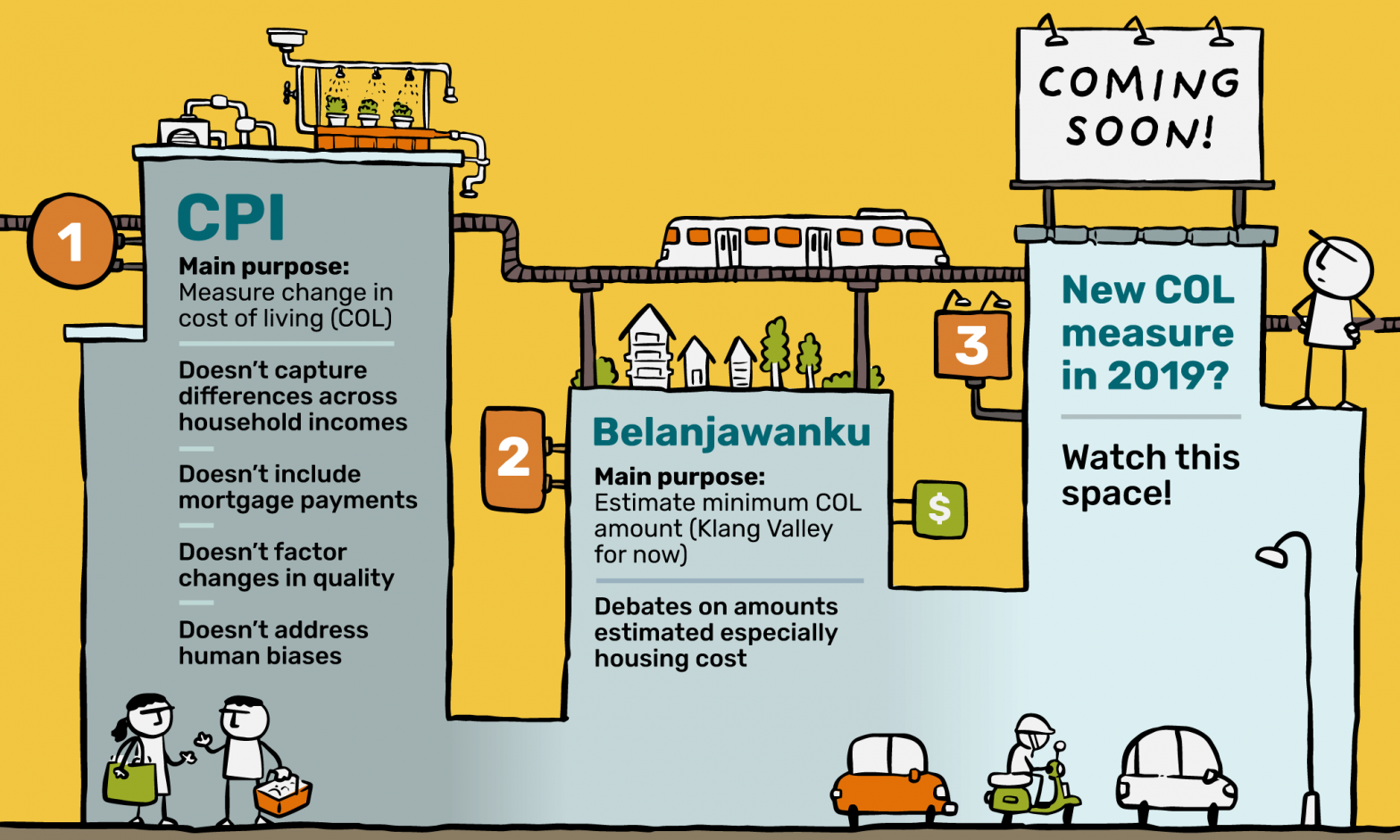
  • There have been some recent attempts at measuring the ‘official’ cost of living in Malaysia*. Historically though, the measure most often referred to is the Consumer Price Index (CPI).

*Not including unofficial estimates e.g. expat forums

  • Strictly speaking, the CPI measures the change in the cost of living; it is not an absolute amount or RM figure. The CPI measures price changes of a constant basket of goods and services that are considered ‘typical’ purchases for a particular population group in Malaysia.
  • The basket comprises 12 categories of goods and services as outlined by the United Nation’s ‘Classification of Individual Consumption According to Purpose’. The weightage between the 12 categories is based on expenditure patterns obtained from the Household Expenditure Survey and is updated periodically*.
Exhibit A: Composition and weightage of CPI; Source: Full Monthly CPI Report, DOSM1 (registration through DOSM portal required for access)
  • In measuring the CPI, the Department of Statistics Malaysia (DOSM) surveys prices of goods and services monthly from about 17,000 retail outlets in Peninsular Malaysia, 2,500 outlets in Sabah and 2,300 outlets in Sarawak*.

*Technical Notes from the full monthly CPI report issued by DOSM. Registration through DOSM portal required for access

What’s the issue with CPI?

  • Using the CPI as the sole or main measure or gauge of the cost of living can be misleading. As mentioned, the CPI is first and foremost a way to measure change in prices i.e. inflation. Nevertheless, even as a measure of inflation, there are a few key issues to be aware of.
  • Firstly, while CPI movements are reported by state and by expenditure category (see DOSM’s CPI report for April 2019), the CPI does not capture the spending basket of households in different income brackets. And different income brackets, across different locations, experience different rates of inflation.
  • In their 2015 Annual Report, Bank Negara Malaysia (BNM) showed that lower income households (LIHs) tend to experience higher rates of inflation. Lower income households in urban areas also tend to experience higher inflation than LIHs living outside the city.
Exhibit B: Inflation by state, area & income group; Source: BNM 2015 Annual Report
  • Secondly, the CPI does not include mortgage payments, only rent. As argued by economists (for example, here), excluding mortgage payments understates the CPI, given the fact that house prices have increased much faster than other measures of inflation in the last decade.
  • Thirdly, the CPI measures pure price movements but not necessarily quality. If prices increase but quality of the relevant goods and services deteriorates, the cost of living could be worse than the rate of inflation suggests. However, if quality has improved along with price increases, the cost of living is arguably improved. Quality changes are hard to quantify of course, but this is worth bearing in mind.
  • Fourthly, our psychological biases. Putting aside the issue of the CPI’s composition for the moment, we as humans tend to make generalisations based on selected information. Research has shown that consumers tend to remember large price changes and prices that have risen rather than those that have fallen. The CPI may not accurately reflect our experience of inflation, but our sense of rising prices may also be magnified by our human biases.

What lies ahead?

  • Having a credible and widely accepted measure of the cost of living is important not only in setting wage and other related policies, but also as a point of reference for ordinary citizens and voters. The Belanjawanku, a collaboration between the EPF and University Malaya’s Social Wellbeing Research Centre published in March 2019, was announced as an attempt in this direction.
  • Said to be based on the actual spending patterns of Klang Valley households, the expenditure guide Belanjawanku shows the minimum monthly spend of six different types of households, from singles to elderly couples. Nevertheless, some questions have been raised about Belanjawanku particularly on the cost of housing, suggesting room for improvement in potential future versions of the guide.

Read our editorial on our suggestions to strengthen the Belanjawanku.

  • In the meantime, the Domestic Trade and Consumer Affairs Minister has cited the establishment of a new cost of living index that would be more reflective of the real cost of living. Among the agencies said to be involved are DOSM, Khazanah Research Institute (KRI) and the Malaysian Competition Commission (MyCC).

Curious about the price of nasi lemak or apples in different states? Check out the Annex to DOSM’s monthly CPI reports

Some questions from fans of policy and ordinary citizens alike:

How should we determine the ‘minimum’ cost of living? Is it related to a minimum quality or standard of goods and services (e.g. housing), and if yes how is that determined?

Even though it’s not politically correct, would it be better to have Cost of Living measurements by income group and location, so that changes for lower income households would be more apparent?


Other useful links:

Inflation and the Cost of Living (BNM)
Cost of Living in Malaysia, crowdsourced (Numbeo)
Malaysia House Price Index (Trading Economics)
Malaysia Food Inflation (Trading Economics)


Email us your views or suggestions at editorial@centre.my.