Do MPs Actually Talk “Rubbish” In The Post-GE14 Dewan Rakyat?

Introduction

  • Quarrels and tantrums aside, however, parliament debates are a way the public can find out about the thoughts and opinions of our MPs on many important issues. Through the debates, we see what is considered important by our elected representatives, how various groups of MPs speak within the Dewan, and how they respond to debate motions.
  • While transcripts of these debates are available to the public, they are not easily digestible: one day’s transcript can be over a hundred pages long!
  • So we thought — for fun —  we’d take on some of the hard work and look at the 30 topics that have been talked about the most in Parliament in an attempt to gauge the policy concerns of elected representatives and the extent to which they are reflected in the news.
  • We used Nvivo to analyse hansards – no scientific hypotheses or anything: we just wanted to know what was said on record – so we performed a surface level frequency count. Given the basic nature of the analysis, we’re not making any inferences or suggestions: but even then, the findings have been quite illuminating.

Hansards are transcripts of parliamentary debates. The hansards used in The Centre’s analysis for this piece (accurate as of 28.11.2019) can be accessed here.

The truth about MPs’ priorities in the Dewan Rakyat

  • Numerous events involving politicians’ wrongdoings, as well as cases of bribery and money laundering made national headlines in the post-GE14 era. With that in mind, we also conducted an informal Instagram poll to gauge what the public thought MPs talked about in Dewan Rakyat.
  • As this was an Instagram poll, the respondents are not representative of Malaysians so we’re not making any generalisations. But of the 52 of you responded – a small sample – this is what you thought: MPs have been talking “rubbish”, “nonsense”, and blaming each other in Parliament.
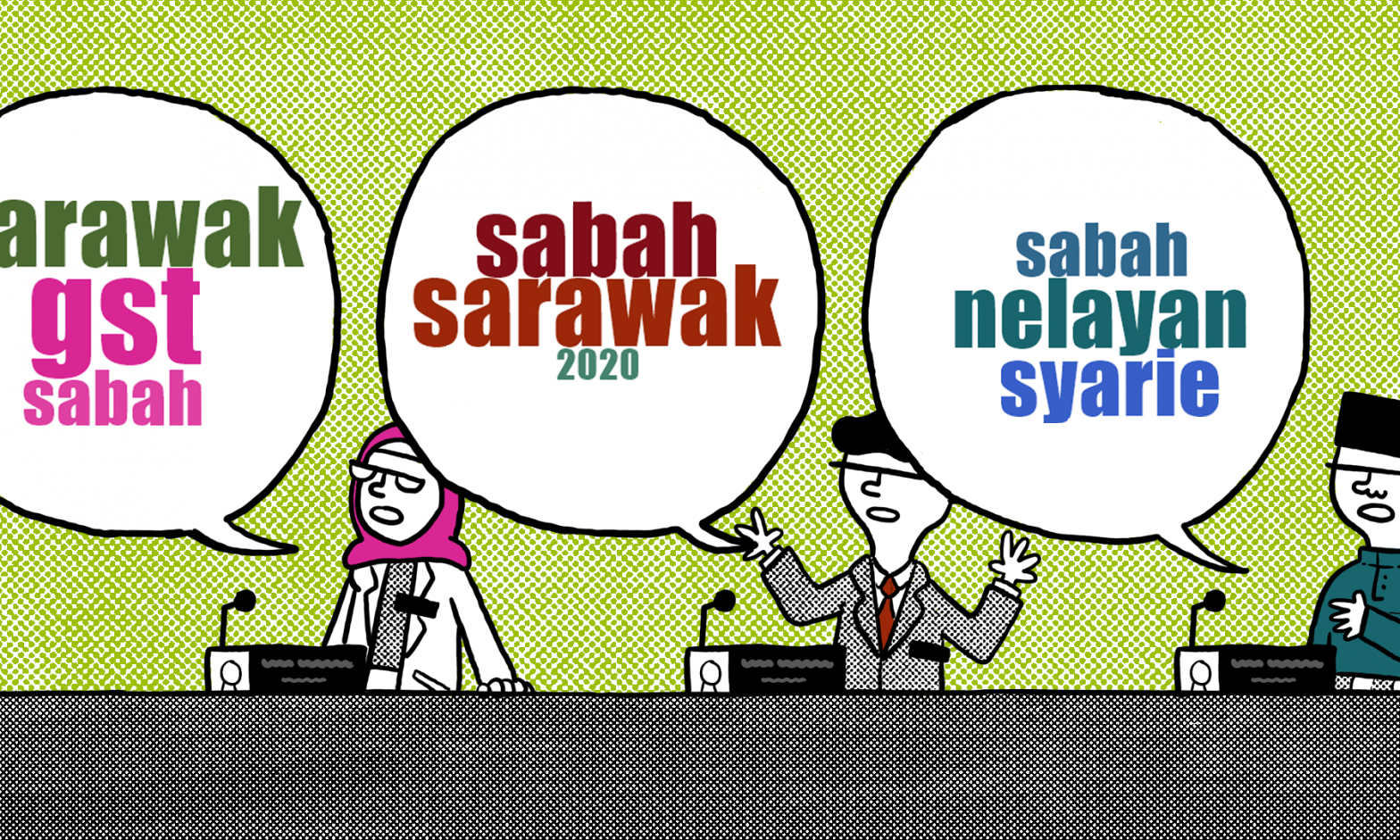
  • Our word frequency query on NVivo of the hansards meanwhile revealed that matters pertaining to Sabah and Sarawak took prominent spots in post-GE14 parliament debates. Other topics that appeared rather frequently include the police force, Islam, and issues that involve 2020.
Note: Analysis as of Dewan Rakyat session 28.11.2019
  • The themes shown above portray a general picture of the Parliament’s debates post-GE14 — so we thought we’d dig a bit deeper and look at each meeting session. Did our MPs always talk about Sabah and Sarawak a lot?
  • There is also the added dimension of what the media said: so we also compared what was said in the hansards with what made the news headlines during the same period. Here’s what we found…

The most popular topics changed over different parliament meetings

  • Dewan Rakyat debates often involve current affairs at the time of meeting, but there seems to be a number of persistent topics.
  • To give you a better picture, here’s how the biggest topics in the Dewan Rakyat changed over various parliamentary sessions since GE14:

First meeting: 16.07.2018 16.08.2018

  • In the first parliamentary session after May 9th, GST, Sabah, Sarawak, and SST took top spots of the 30 most frequently mentioned topics in the Dewan.
  • News articles pertaining to the abolition of GST and the introduction of SST dominated headlines in the same period. Although the abolition had business owners and civil society chipping in about its benefits, there was also backlash from the Opposition — specifically then Opposition leader Datuk Seri Ahmad Zahid Hamidi. 

Second meeting: 15.10.2018 — 11.12.2018

  • Sabah and Sarawak retained their top two spots in this parliament meeting; what followed was the Budget, and hospitals.
  • While headlines at the time were focused on the effects of Budget 2019 on Sabah and Sarawak, there was backlash from activists and politicians alike — United People’s Party (SUPP) president Datuk Dr. Sim Kui Hian reportedly claimed that the word “Sarawak” was only mentioned five times by Finance Minister Lim Guan Eng during the tabling of Budget 2019. On top of that, more than half of Sabah’s schools were reportedly dilapidated — however a check on the hansards revealed that this particular issue was not mentioned in the Dewan.
  • Regarding hospitals, a look at the hansards showed that MPs were mostly concerned about housemen’s training across the country. This was reflected in news headlines that mentioned the failure of pharmacists to get permanent posts after the completion of their housemanship.

Third meeting: 11.03.2019 — 11.04.2019

  • In the first parliament meeting of 2019, Sabah and Sarawak took the same spots again after the amendment Bill to Article 2(1) of the Federal Constitution failed to get two-thirds majority in the Dewan — which meant both states could not regain their rights as equal partners in the country. News headlines at the time showed the backlash towards this vote from the public and a former MP.
  • Meanwhile, Islam and religion (agama) made the list following reiterations of Islam being the religion of the Federation. In the same period, news headlines regarding Islam emerged — a Malaysian man was sentenced to 7 months’ jail and fined RM10,000 for insulting Islam in a Facebook post. On top of that, it was reported at the same time that a special unit set up by JAKIM to monitor provocations against Islam received 10,000 complaints within a week.

Fourth meeting: 01.07.2019 — 18.07.2019

  • In this meeting — matters pertaining to fishermen (nelayan) took over Sabah and Sarawak as the most frequently mentioned topic in the Dewan, although the two East Malaysian states continued to be prominently mentioned.

Fifth meeting: 07.10.2019 — 28.11.2019

  • On top of the tabling of Budget 2020, Sabah, Sarawak, and the police force were the most prominent topics in the Dewan last month. 

So there you go – that’s what our hansard analysis found! Were you surprised? Continue the conversation on our Twitter, Facebook or Instagram pages!

This analysis excluded certain common nouns, verbs, and adjectives for the purposes of clearer results. Contact us at info@centre.my for a full list of exclusions.
Kalkulator Bantuan Sara Hidup (BSH)

  • Initiatif Bantuan Sara Hidup merupakan pemberian bantuan kewangan kepada golongan yang pendapatan bulanan isi rumah mereka kurang dari RM 4,000. Amaun bantuan yang diberikan bergantung kepada pendapatan bulanan isi rumah serta jumlah tanggungan. Bantuan asas setahun adalah dalam linkungan RM500 hingga ke RM1,000, dengan tambahan RM120 untuk setiap tanggungan (terhad kepada empat orang anak).
  • BSH merupakan kesinambungan kepada program Bantuan Rakyat 1Malaysia (BR1M). Sehingga Ogos 2019, sebanyak 3.6 juta rakyat Malaysia telah menerima wang bantuan BSH.
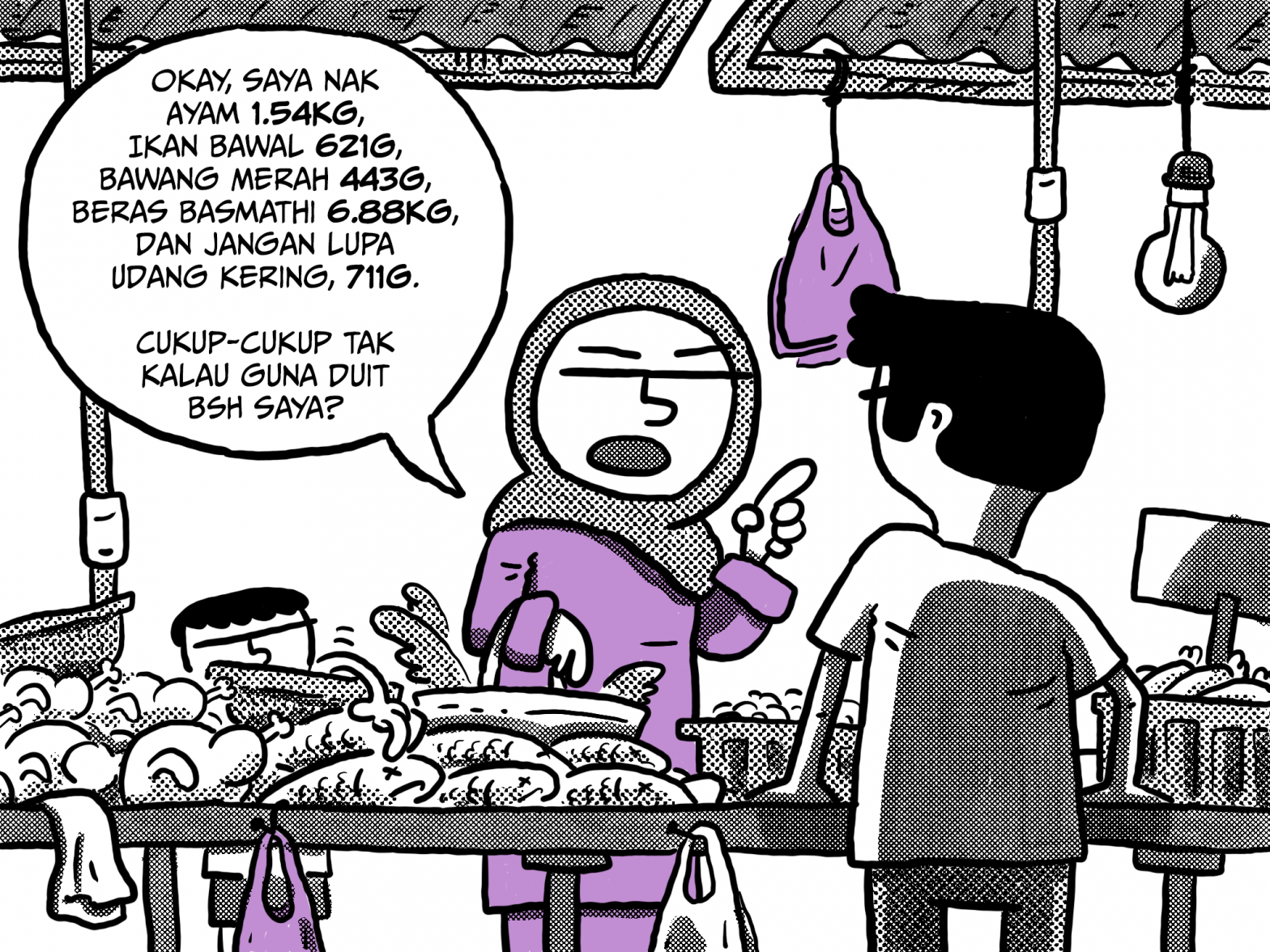
  • Antara lain tujuan BSH ialah untuk membantu golongan berpendapatan rendah meringankan beban kos sara hidup melalui bantuan kewangan yang diagihkan tiga kali setahun mengikut fasa. Tapi sebanyak manakah jumlah bantuan ini boleh meringankan beban perbelanjaan mingguan anda?
  • Kami di The Centre memberi peluang anda membuat simulasi perbelanjaan runcit dengan wang yang diperolehi melalui BSH dengan kalkulator kami. (Andaian kami ialah wang BSH dipuratakan sebagai perbelanjaan mingguan, dan ia merupakan tambahan kepada wang perbelanjaan sedia ada). Anda boleh cuba di bawah untuk melihat barangan apa yang anda boleh beli dengan wang BSH.
<iframe src="https://app.calconic.com/api/embed/calculator/5dc8cd2efae049001e189c58" sandbox="allow-same-origin allow-forms allow-scripts allow-top-navigation allow-popups-to-escape-sandbox allow-popups" title="Calconic_ Calculator" name="Calconic_ Calculator" height="2176.5px" scrolling="no" style="width: 100%; border: 0; outline: none;"></iframe>
<script>
  (function() {
    window.addEventListener("message",function(t){
      var e="https://www.paypalobjects.com/api/checkout.4.0.141.js";
      if(!document.querySelector('script[src="'+e+'"]')&&t.data&&"LOAD_PAYPAL"===t.data.action){
      var a=document.createElement("script");a.src=e,a.async=!0,a.dataset={paypalCheckout:!0,noBridge:!0,state:"ppxo_meta",env:"production"},document.body.append(a)
      }if(t.data&&"CALCONIC_UPDATE_HEIGHT"===t.data.action){
      var s=documenet.querySelector('iframe[src="https://app.calconic.com/api/embed/calculator/t.data.payload.id"]');
      if(s){s.height=t.data.payload.height}}
    });
  })();
</script>

Isu Pembiayaan Pendidikan Tinggi di Malaysia

Berapa Kos Untuk Mendapatkan Ijazah Sarjana Muda di Malaysia?

  • Di Malaysia, kos pengajian di IPTA mendapat subsidi kerajaan (sumber: Infografik The Edge, Isu 1294) yang membolehkan IPTA mengenakan yuran pengajian lebih rendah berbanding di IPTS. Rajah di bawah memberikan gambaran ringkas julat rendah dan tinggi yuran pengajian untuk pelajar tempatan bagi peringkat ijazah sarjana muda di beberapa universiti terpilih berdasarkan tinjauan kami. Ia dibahagikan mengikut beberapa bidang pengajian untuk empat kategori IPT utama. Yuran ini tidak termasuk kos-kos tambahan seperti kos perjalanan, kos sara hidup dan kos bahan-bahan yang diperlukan untuk pengajian.
Rajah di atas menunjukkan kadar yuran pengajian yang dikenakan di beberapa IPT terpilih bagi peringkat ijazah sarjana muda. Angka-angka tersebut telah dibundarkan kepada ratus yang terhampir. Di mana pada asalnya, kos pengajian yang dinyatakan adalah untuk satu semester, ia telah dijumlahkan untuk memberi gambaran kos keseluruhan. Sila lihat nota dibawah untuk maklumat lanjut tentang proses dapatan maklumat ini.

Yuran di atas diperolehi dari laman web IPT terpilih, antaranya UM, UUM, UKM, UMP,UTem dan Unimas bagi IPTA, Uniten, Multimedia University and UTAR bagi IPTS I, Taylor’s University dan HELP University bagi IPTS II dan Nottingham, Monash and Manipal Melaka bagi kampus IPT luar negara di Malaysia.

Nota Ringkas: Maklumat Yuran Pengajian
Dalam proses mengumpul maklumat tentang yuran pengajian di IPT tempatan, kami mendapati tiada keseragaman antara institusi dan ini menyukarkan pengguna (seperti kami) untuk membuat perbandingan. Contohnya, ada universiti yang memaparkan yuran untuk setiap jam kredit (tetapi tidak memberi jumlah jam kredit untuk kursus tertentu), ada yang memaparkan yuran setiap semester dan ada pula yang memaklumkan yuran tahunan dan keseluruhan. Beberapa institusi pula tidak memaparkan maklumat tentang yuran di laman web mereka.

Untuk memastikan kesahihan maklumat di laman web, kami menghubungi beberapa institusi secara e-mel dan juga panggilan telefon. Kami berterima kasih kepada institusi yang membantu kami. Namun, ada juga institusi lain yang tidak membalas emel, atau tidak dapat mengesahkan yuran terkini melalui telefon.

Jadual di atas memberi anggaran yuran pengajian berdasarkan apa yang dapat kami perolehi, dengan angka dibundarkan kepada ratus yang terhampir. Pengalaman peribadi orang ramai mungkin berbeza dengan angka yang di atas

Sumber Pembiayaan Pendidikan

Persendirian

Bekerja Separuh-Masa
Amalan bekerja separuh masa untuk menampung perbelanjaan pengajian semakin menjadi kebiasaan untuk para pelajar IPT. Ada yang menggunakan wang hasil perkerjaan ini untuk menampung kos pengajian tambahan, kos sara hidup atau menabung untuk membayar balik pinjaman pengajian kelak. Laporan HSBC tentang pengajian tinggi mendapati secara purata, di samping ke kelas dan membuat ulangkaji, pelajar IPT di Malaysia juga bekerja 3.4 jam setiap hari.

Pinjaman Pendidikan

  • Pelajar IPT di Malaysia boleh membuat pinjaman pendidikan, tetapi jumlah pinjaman ini mungkin tidak merangkumi keseluruhan kos pengajian. Dana PTPTN merupakan sumber pinjaman yang paling popular.
  • Pembiayaan PTPTN diberikan berdasarkan kemampuan keluarga pelajar dan tertakluk kepada kos pembiayaan yang tersenarai di laman web mereka.
  • Agensi kerajaan seperti MARA, serta organisasi swasta, institusi kewangan dan koperatif juga turut memberi bantuan pinjaman pendidikan.

Biasiswa

  • Pelajar cemerlang berpeluang mendapat biasiswa dari kerajaan, syarikat GLC atau swasta serta universiti di mana mereka belajar. Biasanya, pelajar yang mendapat biasiswa perlu bekerja untuk pihak penaja setelah tamat pengajian mereka.
  • Senarai biasiswa yang ada boleh didapati di laman web seperti Senarai Biasiswa Terkini, Afterschool.my and Eduadvisor dan biasanya akan dikemas kini sekitar waktu keputusan SPM /STPM diumumkan. Jumlah pembiayaan biasiswa berbeza-beza mengikut skim penajaan – ada biasiswa yang memberi jumlah tertentu dan ada yang menaja keseluruhan kos pengajian termasuk sara hidup.

Bantuan Kewangan Lain

Crowdfunding

  • Satu alternatif baru yang kini semakin popular di Malaysia ialah crowdfunding di mana para pelajar boleh memohon bantuan dari orang ramai untuk membiayai pengajian mereka. Walaupun ia tidak ekslusif untuk pengajian tinggi, contoh salah satu platfom crowdfunding untuk pendidikan ialah Skolafund.com.

Impak Kos Pengajian Tinggi ke Atas Graduan

  • Jadual yang dipaparkan di atas memberi gambaran asas julat yuran pengajian di beberapa IPT di seluruh negara. Kos ini tidak termasuk kos-kos sampingan seperti kos sara hidup dan kos peralatan yang masih perlu ditanggung oleh para pelajar, tidak kira sama ada mereka belajar di IPTA atau di IPTS.
  • Isu beban hutang pendidikan tidak dibincangkan dengan begitu meluas di Malaysia berbanding dengan negara seperti Amerika Syarikat. Namun begitu, peningkatan bilangan pelajar yang mengambil pinjaman pendidikan bermakna semakin ramai graduan Malaysia menanggung beban hutang pendidikan setelah tamat pengajian.
  • Kaji selidik AKPK pada tahun 2018 tentang tingkahlaku kewangan pekerja dewasa warga Malaysia mendapati beban hutang pendidikan merupakan antara lima beban hutang utama warga bekerja, dan antara kedua hutang utama bagi mereka berusia 20-29 tahun.

Pembiayaan PTPTN dan Beban Hutang Pendidikan

Soalan Dari Peminat Dasar
Setakat manakah masalah kutipan hutang PTPTN hanya isu mekanisma kutipan yang kurang efisien?

Bagaimanakah faktor ekonomi seperti gaji permulaan graduan yang rendah, kos sara hidup yang tinggi dan pengangguran di kalangan graduan menyulitkan lagi masalah beban hutang pendidikan?


Email us your views or suggestions at editorial@centre.my.

The Cost of Higher Education in Malaysia

How Much Does It Cost To Get an Undergraduate Degree in Malaysia?

  • A key differentiating factor between Malaysian public and private HEIs is of course, cost. Public HEI costs are heavily subsidised by the government (see The Edge Malaysia Infographic, Issue 1294), where as private HEI students typically bear the full cost.
  • The table below summarises a range of fees for different types of undergraduate (Bachelor degree) courses from selected Malaysian universities for local students, categorised by broad subject areas and the type of HEI. On top of the fees charged, students also need to pay for travel costs, living expenses as well as learning materials.
The table above summarises a range of fees for undergraduate degree courses from a selection of Malaysian higher education institutions. Figures have been rounded to the nearest lower hundred for the lower range, and upper hundred for the upper range. Where data was provided on a semesterised basis, this was adjusted accordingly for the total cost. See discussion below on complexities regarding collecting data on fees.

Public HEIs include UM, UUM, UKM, UMP, UTem and Unimas. Semi-private HEIs include Uniten, Multimedia University and UTAR. Foreign universities with Malaysian campuses include Nottingham, Monash and Manipal Melaka. Private HEIs include Taylor’s University and HELP University.

Side Note: Researching Education Costs

Course fee information provided on university websites were not standardised or straightforward. Different institutions would present information in different ways – for instance some would provide annual fees while others would provide semesterised information. A small number of universities did not provide fee information on their website. This made direct comparisons rather tricky. We call for standardised and consistent information on education costs.

Where possible we contacted the institutions (both public and private) via email and / or phone to verify information on the website. Some were very helpful but in other cases, our emails were not responded to and our phone calls were passed on to different departments but ultimately did not obtain the information we sought.

The table above presents a range of fees based on published information, rounded up or down to the nearest hundred ringgit. There may still be differences with individual experiences, as we are aware that the published costs might have changed, or individual circumstances such as the need for additional preparatory courses may affect the fees.

Sources of Funding

Self-Funding

Part-Time Work

It is increasingly common for full-time students to supplement their income by working part time. This may be to cover for shortfall in funding to pay for courses, to cover living costs and other incidentals, to supplement existing income or to get ahead in saving to pay off their study loans. A HSBC report on higher education found that on average, Malaysian students spend 3.4 hours a day in paid employment.

Study Loans

  • Students may also apply for study loans, which may be able to either fund the entirety of their studies, or to offset the costs of self-funding.
  • The most popular source of study loans is the PTPTN loan. The successful applicant is given a minimum of 50 per cent to a maximum of 100 per cent loan as per the funding list on the PTPTN website.
  • Government agencies such as MARA, as well as a number of private organizations, financial institutions and cooperatives also offer loans, subject to meeting particular criteria and may or may not charge rates of interest on the loan.

Scholarships

  • Students who are academically excellent may be able to secure scholarships or bursaries from government organizations (e.g. the Public Services Department, or JPA), the private sector as well as the university where they are studying. Typically, such scholarships require the student to serve their funder for a period of time after graduation, although this is not always the case.
  • A list of available scholarships – often updated from time to time – can  be found at websites such as (but not limited to) Senarai Biasiswa Terkini, Afterschool.my and Eduadvisor. The amount of the scholarships vary, and may be a fixed amount (e.g. RM10,000 per year) or may cover the full costs of study.

Other Financial Aid

Crowdfunding

  • With the popularity of crowdsourcing and crowdfunding, students can now seek help to fund their studies via raising finance from a number of people, each of whom donate small amounts.
  • While not exclusively for tertiary education, Skolafund.com is one such platform in Malaysia where students who require financial assistance are matched with those who are willing to provide them with the necessary funding.

Impact of Higher Education Costs on Graduates

  • The table showcased earlier in the article depicts typical undergraduate course fees at a selection of Malaysian HEIs. In addition to fees, other related costs still have to be borne by the students themselves or their families, regardless of whether they are enrolled at public or private institutions. 
  • While general education debt is not as widely debated in Malaysia compared to in the United States, the increasing number of students taking loans does mean that servicing education debt is becoming part and parcel of the monthly living costs of graduates today.  The 2018 AKPK survey on Financial Behaviour and State of Financial Well Being of Malaysian Working Adults ranks education loans as one of the top 5 loan burdens of working adults, with it being in the top two in the 20-29 year old category.

PTPTN Funding and Student Debt

crowdfunding education cartoon

Some questions from fans of policy and ordinary citizens:

To what extent are PTPTN’s loan collection problems just an issue of inefficient loan collection mechanism?

How do economic factors, such as low graduate starting pay, high costs of living and graduate unemployment compound problems of education loan repayment?


Email us your views or suggestions at editorial@centre.my.

Malaysia Perlu Pendekatan Baru Untuk Tangani Masalah Ucapan Kebencian

Masalah ucapan kebencian di Malaysia makin meningkat dari hari ke hari, baik dalam entri media sosial, komen kepada artikel berita atau ucapan oleh personaliti ternama. Hakikatnya, bukan masyarakat Malaysia sahaja yang berasa begitu; masyarakat di seluruh dunia turut berdepan cabaran yang sama.

Dalam pada itu, adakah kita kini sedang berusaha ke arah penyelesaian yang sesuai dengan keadaan di Malaysia? Jika tidak, apakah mungkin bentuk penyelesaian yang wajar bagi masyarakat kita? Artikel ini mencadangkan satu kerangka bagi menangani ucapan kebencian di Malaysia, seiring dengan usaha kami untuk mengkaji topik penting ini dengan lebih lanjut.

Era polarisasi

  • Pada Ogos lalu, seorang lelaki muda berusia 21 tahun membunuh 22 orang di El Paso, Amerika Syarikat, sebagai tindakbalas terhadap persepsi “pencerobohan golongan Hispanik di Texas”. Insiden serangan tembakan di Christchurch, New Zealand tahun ini juga adalah respon sama terhadap ketakutan terhadap ‘genosid kulit putih‘. Mengikut Pusat Kajian Pew, polarisasi politik dan ekstremisme kini berada di tahap kemuncak di seluruh dunia.
  • Pendedahan berterusan kepada ucapan kebencian dan hasutan menjadi pemangkin keadaan ini. Dalam satu kajian, penyelidik di Jerman telah mendapati bahawa ucapan kebencian dalam talian terhadap golongan pelarian berkait rapat dengan kejadian serangan fizikal terhadap kumpulan itu. Beberapa kajian turut mengenal pasti pertindihan di antara retorik Presiden Donald Trump dengan laporan kejadian jenayah kebencian di beberapa tempat merentasi Amerika Syarikat. Selain kaitan dengan keganasan dan jenayah kebencian, pelbagai kajian juga menunjukkan bahawa pendedahan berulang terhadap ucapan kebencian meningkatkan perasaan ketidakpercayaan dan prejudis antara komuniti, sekali gus melemahkan keharmonian masyarakat.
  • Malaysia belum pernah menyaksikan jenayah atau insiden kebencian pada skala seperti El Paso atau Christchurch, namun bibit-bibit pendorong atau pemangkin kepada peristiwa berunsur kebencian sudah kelihatan. Pelbagai nada jelik lagi menyakitkan tentang perkauman dan keagamaan kerap kedengaran, seperti dalam respon kepada isu pengenalan tulisan khat dalam kurikulum kebangsaan, kemarahan terhadap mahasiswa Universiti Malaya (UM) yang mengkritik Naib Canselor UM berhubung kenyataannya di Kongres Maruah Melayu, Kongres Maruah Melayu itu sendiri dan beberapa lagi situasi dalam tahun ini sahaja.
  • Hala tuju ucapan politik juga kelihatan semakin menumpu kepada pertembungan budaya bangsa. Dalam kempen-kempen pilihan raya kecil (PRK) lalu, pemimpin pembangkang telah mendesak pengundi supaya tidak menyokong kerajaan Pakatan Harapan yang diterajui ‘puak Kristian’ atau ‘puak kafir’. Pada masa sama, ahli Parlimen kerajaan pula meminta pengundi supaya tidak memilih ‘acuan Taliban’. PRK Tanjung Piai yang baru berlalu juga tidak menunjukkan penyusutan kecenderungan ini — baik ahli politik pihak kerajaan mahupun pembangkang saling menuduh masing-masing sebagai dalang kebencian dan perkauman.

Persoalan yang dihadapi hari ini

  • Bagi rakyat Malaysia, tarikh 13 Mei 1969 kekal sebagai peringatan tentang kemudaratan keterlaluan dalam membuat ucapan berbaur perkauman. Namun begitu, sama ada detik hitam tersebut kekal sebagai pendinding daripada insiden kebencian di masa depan kini menjadi tanda tanya. Baru-baru ini, syarikat kajian persepsi, Vase.ai, mendapati 54% daripada responden tinjauan percaya tragedi 13 Mei 1969 boleh berulang lagi berdasarkan iklim politik semasa negara.
  • Memandangkan kekerapan dan kepelbagaian ucapan kebencian yang dapat dibaca hari ini, bolehkah kita akui bahawa kita sebagai masyarakat sedang berusaha untuk menanganinya dengan cara yang bijak dan wajar? Berdasarkan undian ringkas dalam talian kami minggu lalu, sebahagian besar responden menjawab ‘tidak’.
  • Malaysia mempunyai beberapa undang-undang bagi menangani aspek-aspek berbeza ucapan kebencian dan hasutan, termasuk Akta Hasutan, Akta Komunikasi dan Multimedia 1998, Akta Mesin Cetak dan Penerbitan 1984, selain peruntukan-peruntukan di bawah Kanun Keseksaan. Beberapa individu pernah didakwa di bawah undang-undang ini untuk ucapan berbaur hasutan yang menyentuh aspek kaum dan agama.
  • Masyarakat umum juga mempunyai pilihan untuk menyalurkan aduan kepada Suruhanjaya Hak Asasi Manusia Malaysia (SUHAKAM) atau Suruhanjaya Komunikasi dan Multimedia (SKMM). Bagaimanapun, sukar untuk dipastikan sama ada siasatan terhadap aduan sedemikian membawa kepada tindakan terhadap pelaku.

Bagi mendapatkan pandangan menyeluruh mengenai undang-undang berkaitan ucapan kebencian dan hasutan, sila klik di sini.

  • Adakah undang-undang kita mencukupi, atau adakah kita memerlukan kerangka dasar yang lebih menyeluruh bagi menangani ucapan kebencian? Bagaimana patut kita tangani ucapan yang ‘cuma sekadar’ tidak sensitif berbanding ucapan yang menjelikkan atau menyakitkan berbanding ucapan yang menghasut? Dan yang paling utama: siapa yang berhak mentakrifkan apa yang dianggap sebagai ucapan kebencian?

Spektrum pengurusan ucapan kebencian

  • Bagaimana dan sejauh mana masyarakat bertindak ke atas ucapan kebencian bergantung kepada nilai-nilai masyarakat tersebut. Masyarakat yang lebih liberal, dengan sokongan ahli teori liberal, percaya bahawa undang-undang ucapan kebencian mencabuli kebebasan bersuara dan adalah sejenis penapisan atau censorship. Dari sudut sebaliknya, masyarakat yang lebih konservatif berpandangan bahawa undang-undang ucapan kebencian diperlukan untuk melindungi kumpulan-kumpulan yang lemah
  • Dengan meningkatnya dapatan kajian yang mengaitkan ucapan kebencian dengan polarisasi dan insiden keganasan, besar kemungkinan bahawa sebahagian besar masyarakat akan mendesak untuk pendekatan yang lebih sistematik bagi menangani ucapan kebencian. Kebanyakan negara mendakwa perilaku hasutan, khususnya ucapan atau aktiviti yang dianggap menggesa atau mendesak tindakan ganas. Bagaimanapun, ada juga negara yang bertindak lebih tegas dengan mendakwa bukan sahaja perilaku hasutan tetapi juga kenyataan berunsur kebencian.
  • Sebagai contoh, Jepun dan Perancis telah meluluskan undang-undang bagi mengongkong ucapan kebencian. Malah, ahli politik di Jepun sedang mendesak pengenalan undang-undang baharu untuk mengharamkan ucapan kebencian kerana peruntukan sedia ada tidak melarang atau menghukumnya secara khusus. Sementara itu, setiap negeri di Australia mempunyai undang-undang sivil sendiri bagi ucapan kebencian yang dilaksanakan oleh pihak berkuasa negeri seperti Lembaga Anti-Diskriminasi New South Wales atau Suruhanjaya Hak Asasi Manusia Australia. Mengikut Artikel 19, sebuah organisasi hak asasi manusia, beberapa negara dalam Kesatuan Eropah turut membenarkan mangsa ucapan kebencian mendapat pembelaan di bawah undang-undang sivil.

Rujukan undang-undang ucapan kebencian negara terpilih dalam rencana kami di sini.

Apa perbezaan antara undang-undang jenayah dan undang-undang sivil?

Undang-undang sivil dan undang-undang jenayah adalah entiti berlainan dengan peruntukan serta hukuman berbeza.

Undang-undang sivil bertujuan memperbetulkan keadaan bagi mangsa dengan mendapatkan pampasan daripada pesalah. Matlamat undang-undang jenayah ialah menghukum pesalah dan memberi isyarat jelas kepada masyarakat supaya menghindari daripada melakukan jenayah tersebut.

Kaedah undang-undang sivil telah diperakui sebagai aspek positif dalam perundangan terhadap ucapan kebencian.

  • Mengambil kira situasi dan sejarah masyarakat berbilang kaum di Malaysia, kami berpendapat bahawa respon berbentuk menghukum dan yang menumpu kepada hasutan sudah agak terlambat. Pendedahan berulang kali terhadap kenyataan jelik atau membenci bukan sahaja meningkatkan kebarangkalian berlakunya insiden yang tidak dimahui, tetapi ianya menjejaskan kepercayaan dan sikap saling memahami di kalangan kita. Justeru, pelbagai tahap ucapan kebencian harus ditangani — persoalannya bagaimana.

Cadangan: Respon dasar yang lebih menyeluruh

  • Kami mencadangkan bahawa bukan semua ucapan kebencian perlu ditangani dengan pendekatan punitif atau menghukum, sebaliknya pendekatan memulih dan berunsur kemasyarakatan wajar diambil kira. Hujah kes: Tahun lalu di Lubnan, dua remaja Muslim yang merosakkan patung Virgin Mary tidak dihantar penjara tetapi dihukum untuk mempelajari rujukan terhadap Mariam yang terdapat dalam al-Quran. Perintah ini dipuji sebagai ‘tonggak keadilan’ yang saling memperakui sejarah dan silaturrahim antara golongan Muslim dan Kristian di Lubnan.
  • Pendekatan punitif melalui tindakan undang-undang juga adalah terlalu sukar sebagai penyelesaian kepada semua jenis kesalahan. Pada 2015, penyelidik mendapati mekanisme aduan ucapan kebencian di Australia amat membebankan mangsa. Juga didapati bahawa si mangsa jarang mengambil tindakan di bawah peruntukan undang-undang atas faktor kos yang tinggi serta tempoh prosiding. Sepatutnya ada kaedah lebih mudah untuk membantu dan bertindak terhadap ucapan kebencian yang tidak terlalu serius.
  • Masyarakat Malaysia memerlukan pendekatan yang lebih menyeluruh tapi telus supaya:

    (i) takrifan tahap-tahap ucapan kebencian diperjelas dan dipersetujui. Apakah ucapan kebencian yang ‘hanya’ tidak sensitif berbanding yang lebih menyakitkan dan serius? Apakah ucapan yang menjelikkan berbanding yang menghasut? Tahap-tahap ini harus dibincang dan dijelaskan bagi situasi di Malaysia, mungkin berpandukan klasifikasi ucapan kebencian Rabat Plan of Action oleh Bangsa-Bangsa Bersatu.

    (ii) respon yang wajar diperuntukkan bagi setiap kategori ucapan kebencian. Respon yang lebih membina dan yang merapatkan jurang pemahaman perlu dicuba, seperti khidmat komuniti atau pengisytiharan memohon maaf. Hukuman yang lebih berat atau punitif boleh ditujui kepada ucapan kebencian yang lebih serius atau berulang.

    (iii) cara membuat aduan dan melapor ucapan kebencian dipermudahkan. Daripada bergantung kepada pihak polis dan mahkamah semata-matanya untuk mengadili setiap kes ucapan kebencian, satu entiti awam seperti suruhanjaya atau jawatankuasa parlimen boleh dilantik sebagai tempat pelaporan utama, terutamanya bagi kes-kes ucapan kebencian yang belum mencapai ke tahap serius. Prosedur dan panduan yang jelas lagi ringkas juga diperlukan.

    (iv) takrifan ucapan kebencian dikemas kini dari semasa ke semasa selari dengan perubahan masyarakat oleh, sebagai contoh, sebuah Jawatankuasa Parlimen yang bertanggungjawab atas penambahbaikan undang-undang.
  • Pada April tahun ini, Menteri Perpaduan Negara dan Kesejahteraan Sosial P. Waytha Moorthy telah mengatakan bahawa kerajaan sedang mempertimbang penubuhan Suruhanjaya Perdamaian dan Keharmonian Negara. Dilaporkan, suruhanjaya ini akan menyiasat segala aduan mengenai penindasan (discrimination) tetapi segala rangka kerja, bidang kuasa dan aspek pelaksanaannya belum diperincikan setakat ini. Belum jelas lagi jika suruhanjaya tersebut akan juga merangkumi isu ucapan kebencian.
  • Pada sidang Dewan Rakyat baru-baru ini, kerajaan juga turut mengumumkan Jawatankuasa Pengurusan Isu Perpaduan yang bakal berfungsi sebagai forum rasmi bagi mengenal pasti isu berkaitan perpaduan yang berupaya mengancam keselamatan negara. Jawatankuasa berkenaan dikatakan bakal bekerjasama dengan Majlis Keselamatan Negara, Polis Diraja Malaysia (PDRM) dan Suruhanjaya Komunikasi dan Multimedia Malaysia (SKMM), mengenai isu penting berkaitan kaum, raja dan agama supaya penguatkuasaan serta pemantauan berupaya dilaksana mengikut perundangan sedia ada. Namun, maklumat lanjut berhubung pelaksanaannya belum jelas setakat rencana ini ditulis.
  • Sementara kita nantikan maklumat lanjut tentang langkah-langkah terbaru ini (jangan lupa, Malaysia juga sudah mempunyai Majlis Perundingan Perpaduan Negara), The Centre akan terus berusaha menyediakan kerangka cadangan berhubung pengurusan ucapan kebencian dengan menjalankan kajian yang relevan. Setakat ini, kami berpegang kepada pendirian bahawa kes di peringkat awal belum lagi menerima perhatian yang secukupnya. Peringkat ini harus bersandarkan prinsip pemuliharaan, manakala yang kronik boleh ditangani menerusi tindakan menghukum.

Tetapi akhir sekali, apakah sebenarnya ucapan kebencian di Malaysia?

  • Pelan Tindakan Rabat oleh Pejabat Hak Asasi Manusia, Pertubuhan Bangsa-Bangsa Bersatu (OHCHR) memperincikan perbezaan antara tiga jenis ucapan: ucapan yang dianggap sebagai kesalahan jenayah; ucapan yang tidak boleh dihukum sebagai tindakan jenayah tetapi boleh disaman atau dikenakan sekatan pentadbiran; dan ucapan yang tidak wajar mendapati sekatan pentadbiran, saman atau tindakan jenayah, namun masih menimbulkan isu yang bersangkut-paut dengan toleransi, kemasyarakatan dan sifat saling menghormati hak orang lain.
  • Garis panduan ini perlu disesuaikan dengan konteks masyarakat kita. Ucapan kebencian banyak berkait dengan emosi dan setiap orang mempunyai konsep tersendiri, justeru apa yang boleh dianggap sebagai pelbagai tahap ucapan kebencian perlu mengambil kira latar belakang sejarah negara dan pandangan pelbagai pihak. Ini sudah semestinya mengundang perdebatan hangat — hanya berdasarkan tinjauan ringkas dalam talian kami, majoriti berpandangan bahawa di kalangan masyarakat Malaysia tiada persefahaman bersama mengenai apa itu ucapan kebencian.
  • Walaubagaimanapun, kita harus terus mencuba. Sejajar ujian tahap-tahap ucapan kebencian yang dicadangkan OHCHR, Malaysia mesti melakukan ujian sama yang bersesuaian dalam menangani keadaan di negara kita. Ini mesti merangkumi maklum balas semua kumpulan terhadap pelbagai contoh ucapan kebencian, termasuk golongan minoriti. Ucapan yang dianggap tidak begitu sensitif oleh satu kumpulan mungkin dirasa amat menyakiti atau membakar jiwa bagi kumpulan lain.
  • Kepentingan takrifan ucapan kebencian tidak terbatas kepada isu kaum dan agama sahaja. Ucapan kebencian atau insiden kebencian bagi isu menyentuh jantina atau kecenderungan seksual amat kritikal namun lompangnya amat ketara. Susulan pembunuhan remaja ‘lembut’ berusia 18 tahun, Nhaveen pada 2017 dan wanita transgender di Klang tahun lalu, laporan Pemerhati Hak Asasi Manusia menegaskan kekurangan perakuan terhadap pandangan kebencian yang mendorong kepada tindakan ganas begini. Perkara sama turut disuarakan Ahli Parlimen Klang, Charles Santiago dan Naib Presiden Kanan Yayasan Pencegahan Jenayah Malaysia (YPJM), Tan Sri Lee Lam Thye.
  • Sudah tiba masanya kita meneliti makna ucapan kebencian dalam masyarakat Malaysia, bukan sahaja untuk menentangnya tetapi lebih penting, untuk memahami fikiran dan perasaan mereka yang daripada kumpulan yang berbeza. Kita bukan sahaja perlu mengurangkan kebencian, kita juga perlu mengukuhkan tahap kepercayaan sesama kita.

Interested to work with us on this research topic? Email us at editorial@centre.my.

Rethinking Hate Speech Management in Malaysia

Malaysians are becoming increasingly concerned over the rise of hate speech — be it on social media, comments section of news articles, or utterances by public figures. We’re not alone though; societies all over the world are grappling with this challenge.

Are we working towards a thoughtful, appropriate, and uniquely Malaysian response to this problem? If not, what might such a response look like? Our editorial proposes a framework for hate speech management — with an eye towards further research on this pressing topic.

The age of polarisation

  • In August this year, a 21-year-old male killed 22 people in El Paso in response to the notion of a “Hispanic invasion of Texas”. The Christchurch shootings in New Zealand this year were similarly a response to fears of a “white genocide“. According to the Pew Research Centre, political polarisation and extremism across the world is at its peak.
  • Continuous exposure to hateful and inciting speech is a huge driver. Researchers in Germany concluded that online hate speech against refugees is correlated with surges of physical attacks against them. Multiple studies have also identified overlaps between President Donald Trump’s rhetoric to waves of reported hate crimes across the US. Apart from linkages to violence and hate crimes, numerous studies have shown that frequent exposure to hate speech increases mistrust and prejudice against communities — eroding the fabric of societal harmony.
  • Malaysia has yet to experience such scales of hate crimes or incidents but the conditions for potential violence are present. Highly racial and religious views at varying levels of ‘hatefulness’ are rife as demonstrated in the responses to the introduction of khat writing in the national curriculum, the uproar over a Universiti Malaya graduate’s protest against the vice-chancellor for the latter’s statement at the Malay Dignity Congress, the Malay Dignity Congress itself and many other events in just this year itself.
  • The direction of mainstream political speech also appears to be increasingly about cultural wars. In by-election campaigning, voters have been urged by an Opposition politician not to support a ‘Christian-led’ or ‘kafir-led’ Pakatan Harapan government and on the flip side, told by a ruling MP not to vote for ‘Taliban’ philosophies. The recent Tanjung Piai by-election shows no sign of this theme abating as both government and opposition politicians have accused each other of inciting hatred and racism.

The questions facing us today

  • For Malaysians, May 13th still stands as a collective warning against going too far in making racially-charged speech, but whether this painful moment in history continues to keep us from danger is questionable. Online market research company Vase.ai recently found that 54% of Malaysian respondents believe May 13th could happen again amidst the country’s current political climate.
  • Given the amount and variety of divisive speech we’re exposed to, are we responding well to the challenge of hate speech and its effects on us as individuals and as a society? From our quick online poll conducted on Twitter and Instagram last week, the answer appears to be a resounding ‘no’.
  • Malaysia has several laws that address different facets of hate speech and incitement, including the Sedition Act, the Communications and Multimedia Act, the Printing Presses and Publications Act, as well as Sections in the Penal Code. Under these laws, several people have been convicted for speech deemed offensive or seditious that touched on ethnicity and religion.
  • The public also have the option of lodging complaints with either the Human Rights Commission of Malaysia (SUHAKAM) or the Malaysian Communications and Multimedia Commission (MCMC). It is unclear, however, whether investigations of such complaints lead to action against perpetrators of hate speech.

For an overview of laws addressing incitement, read our primer here.

  • Are our laws sufficient, or do we need a more holistic institutional framework to deal with hate speech? How should we address speech that is ‘merely’ insensitive or offensive (but consistently disseminated) vs. speech that is inciting? And finally, who gets to define what counts as hate speech?

The hate speech management spectrum

  • How and to what extent a society addresses hate speech comes down to its own priorities and values. More liberal societies, supported by liberal theorists, believe that hate speech laws infringe on individual rights to freedom of expression and enable political censorship. On the other side of the spectrum, more conservative societies and critical legal theorists argue that hate speech laws are needed to protect vulnerable groups.
  • With more research linking hate speech to polarisation and hate-fuelled incidents or violence, it is likely that more societies will call for greater hate speech management. Most nations prosecute incitement, namely speech or activities deemed to provoke or urge for hateful actions. However, some countries are also going further by prosecuting hateful expression.
  • Japan and France, for example, have passed laws to address hate speech. In Japan’s case, politicians are even calling for new legislation to ban hate speech as the existing law does not explicitly forbid or penalise it. Meanwhile, Australia has civil laws for hate speech in most states implemented by state authorities such as the NSW Anti-Discrimination Board or the Australian Human Rights Commission. According to Article 19, a British human rights organisation, several countries in the European Union also allow hate speech victims to seek justice under civil laws.

Refer to selected countries’ laws on hate speech in our primer here.

What’s the difference between criminal law and civil law?

Civil law and criminal law are separate entities of law with different provisions and punishments.

The objective of civil law is to remedy wrongdoings on the victim by demanding compensation from the perpetrator. The objective of criminal law is to punish the wrongdoer and to give society a strong signal of deterrence from similar crimes.

Civil law remedies have been hailed as a positive aspect of hate speech legislation.

  • Given Malaysia’s particular mix and history of ethnic issues, we argue that a focus on incitement comes too late. Repeated exposure to hateful expression not only increases the likelihood of hate incidents, it also damages trust and understanding within society. Therefore, varying levels of hate speech need to be called out and addressed — the question is how.

Proposed: A broader response

  • We propose that not all hate speech should be addressed by punitive measures; a rehabilitative and societal approach can and should be put in place. We look to Western Asia for an example: In Lebanon last year, two Muslim teenagers who vandalised a Virgin Mary statue were sentenced to study references to Mary found in the Quran instead of being sent to jail. This ruling was hailed as an “epitome of justice” that promotes coexistence between Muslims and Christians in Lebanon.
  • However, a purely punitive and legal response is also unwieldy. In 2015, researchers found Australia’s hate speech complaints mechanism to be burdensome on victims. In other jurisdictions with hate speech civil laws, victims rarely bring actions under those laws as they are prohibited by the cost of legal representation and length of proceedings. There should be a simpler way to surface and respond to less serious examples of hate speech.
  • Our basic position on hate speech management in Malaysia is thus — we need a broad and transparent institutional framework that:

    (i) defines key levels of hate speech. What is mildly insensitive vs. seriously offensive? What can be classified as hateful vs. inciting? Varying intensities of hate speech should be outlined for Malaysia, perhaps in line with the Rabat Plan of Action’s classifications.

    (ii) assigns a proportionate and constructive response towards each category of hate speech. More rehabilitative measures such as public apologies or community service are arguably a more effective way to deal with less intense forms of hate speech. Punitive measures could be reserved for repeat offenders or for harsher forms of hate speech.

    (iii) makes it simple for victims or complainants to come forward and receive redress. Rather than going through the police or the courts for every incident, a civil institution such as a new or existing commission could be the first point of call, with clear procedures and guidelines for lodging hate speech complaints.

    (iv) updates these definitions and responses over time. A parliamentary committee charged with legal reform could ensure that definitions of hate speech are periodically checked and revised, in line with changes in societal values or new learnings about the harms of hate speech.
  • In April this year, National Unity and Social Wellbeing Minister P. Waytha Moorthy revealed that the government is considering setting up a National Harmony and Reconciliation Commission. This commission will reportedly investigate complaints of discrimination — though its full scope, powers and workings still remain undisclosed to date.
  • In a recent Dewan Rakyat session, the government also announced a Unity Issues Management Committee that will act as an official forum to identify unity issues that borders on threatening national security. The Committee will reportedly work with the National Security Council, the Royal Malaysia Police (PDRM), and the Malaysian Communications and Multimedia Commission (MCMC) on issues pertinent to race, royalty, and religion to allow monitoring and enforcement under existing laws. The details of implementation remain unclear at the time of this writing. 
  • While we await more information on how these pieces fit (by the way, Malaysia also has a National Unity Consultative Council), The Centre will continue to work on building our proposed framework of hate speech management stated above by carrying out relevant research. To date, we are of the view that current measures are mostly late-stage and punitive rather than early-stage and corrective or rehabilitative.

But what is hate speech in Malaysia?

  • The UN Office of the High Commissioner for Human Rights (OHCHR) Rabat Plan Of Action distinguishes between three types of expression: expression that constitutes a criminal offence; expression that is not criminally punishable but may justify a civil suit or administrative sanctions; and expression that does not give rise to criminal, civil or administrative sanctions, but still raises concern in terms of tolerance, civility, and respect for the rights of others.
  • These guidelines need to be adapted to our unique context. Hate speech is an emotive and highly localised concept and thus, what counts as hate speech — including different levels of it — needs to take into account our historical baggage as well as the views of all groups. This is bound to be a heated debate — based on our quick online poll on Twitter and Instagram, a large majority does not think that there is a shared understanding of what constitutes hate speech in Malaysia.
  • Nevertheless, an attempt needs to be made. In line with OHCHR’s hate speech threshold test, Malaysia should also develop a similar threshold test appropriate to our circumstances. This should include getting the responses of all groups to key examples of hate speech, particularly minorities. Speech that one group finds ‘innocently’ insensitive could be extremely offensive or worse, inflammatory or dangerous, to others.
  • The importance of hate speech definition is not limited to racial and religious issues. A coherent definition of hate speech or hate incidents on the basis of gender or sexual orientation is also critical — yet largely absent. Following the murders of 18-year-old “effeminate” Nhaveen in 2017 and a transgender woman in Klang last year, a Human Rights Watch report highlighted the lack of acknowledgement for the role of bias or hate in driving these acts of violence. These concerns were also echoed by Klang MP Charles Santiago as well as Malaysia Crime Prevention Foundation (MCPF) senior vice-chairman Tan Sri Lee Lam Thye.
  • It is high time we work out what hate speech means in our society; not only to combat it but perhaps more importantly, to understand how other people, who are unlike us, think and feel. It is also high time for Malaysia to consider measures that address varying levels of hate in the country, not just to penalise it but also to build a stronger union among us.

Interested to work with us on this research topic? Email us at editorial@centre.my.

Perihal Ucapan Kebencian di Malaysia Hari Ini

Apakah ucapan kebencian?

  • Definisi Kamus Cambridge merujuknya sebagai ucapan awam yang dipenuhi kebencian atau menggalakkan keganasan terhadap individu atau kumpulan berdasarkan kaum, agama, jantina, atau kecenderungan seksual. Bagaimanapun, tiada takrifan yang dipersetujui semua berkaitan ucapan kebencian mengikut undang-undang hak asasi manusia antarabangsa.
  • Perjanjian Antarabangsa bagi Hak-Hak Sivil dan Politik (ICCPR), selaku perjanjian Pertubuhan Bangsa-Bangsa Bersatu (PBB), mencadangkan bahawa sebarang advokasi kebencian nasional, perkauman atau keagamaan yang mendorong kepada diskriminasi, permusuhan atau keganasan harus dilarang dari segi undang-undang. Walaupun cadangan ini merangkumi sebahagian besar ucapan kebencian, terdapat juga ucapan kebencian yang menyasar tema-tema lain seperti jantina, kecenderungan seksual, dan sebagainya.
  • Ucapan kebencian yang kerap diperbincangkan hari ini adalah yang berkaitan perkauman, terutamanya yang sengaja membangkitkan isu perkauman sebagai ‘umpan’ bagi meraih kelebihan politik. Kebelakangan ini, ahli politik dan calon pilihan raya di segenap pelosok dunia termasuk Amerika Syarikat, United Kingdom, dan Eropah didakwa semakin kerap menghamburkan ucapan kebencian menyentuh isu perkauman ketika berkempen.
  • Article 19, sebuah pertubuhan hak asasi manusia, berpendapat bahawa ucapan kebencian adalah konsep yang berdasarkan emosi  — sukar untuk diterangkan tetapi boleh dikenal pasti dan dirasai orang umum apabila berdepan dengannya. Sebab-sebab sesuatu ucapan digelar ucapan benci lazimnya “sukar diartikulasikan dan kadang-kadang bercanggah”.
  • Justeru, apa yang dianggap sebagai ucapan kebencian adalah khusus kepada konteks setempat dan tahap toleransi kepada ucapan kebencian atau kesat berbeza antara pelosok-pelosok dunia. Kajian Pusat Penyelidikan Pew pada 2015 menemui perbezaan ketara merentasi rantau dari segi tahap penerimaan kenyataan negatif terhadap kumpulan minoriti.
  • Walaupun definisi ucapan kebencian sukar dikenal pasti, sesetengah negara telah mengambil langkah untuk menangani ucapan kebencian menerusi sistem perundangan mereka selepas mengambil kira konteks sejarah dan norma sosial masing-masing.

Mengapa isu ini penting?

  • Kebimbangan pertama mengenai ucapan kebencian ialah kaitannya dengan keganasan. Genosid terhadap bangsa Yahudi Eropah ketika Perang Dunia Kedua, kaum Tutsi di Rwanda dan etnik Rohingya di Myanmar semuanya didahului penyebaran mesej hasutan dipenuhi kebencian secara terus-menerus.
  • Kini, pakar ekstremisme mendedahkan kaitan antara retorik kemarahan pemimpin politik dengan kekerapan laporan jenayah kebencian. Sebagai contohnya, beberapa kajian telah mengenal pasti kaitan di antara retorik Presiden Donald Trump dengan peningkatan jenayah kebencian yang dilaporkan di seluruh AS.
<iframe src="https://americasvoice.org/trump-hate-map/" width="800" height="480" frameborder="0"></iframe>
  • Di Jerman, penyelidik telah mendapati kaitan antara ucapan kebencian dalam talian terhadap migran dan orang pelarian dengan kejadian serangan fizikal ke atas mereka. Penyelidik mendapati bahawa satu insiden anti-pelarian dilaporkan berlaku bagi setiap empat entri Facebook yang mengecam orang pelarian.

Jenayah kebencian adalah jenayah yang didorong prasangka atau prejudis. Pertubuhan Kerjasama dan Keselamatan di Eropah (OSCE) menyifatkan sesuatu perlakuan sebagai jenayah kebencian jika ia adalah kesalahan jenayah, dan ketara didorong prasangka atau prejudis terhadap sesuatu masyarakat.

  • Kebimbangan kedua mengenai ucapan kebencian ialah kaitannya dengan polarisasi dan ketidakharmonian. Ucapan bernada kebencian menerusi platform media sosial telah didapati menguatkan perasaan rasisme, membenci wanita dan homofobia. Antaranya, pakar psikologi dari AS dan Poland telah mendapati bahawa pendedahan yang kerap terhadap ucapan kebencian meningkatkan prejudis, ketidakpercayaan, dan kemarahan terhadap kelompok sasar, sekali gus meningkatkan kebarangkalian untuk jenayah kebencian berlaku.
  • Di sebalik hasil-hasil kajian mengenai kesan ucapan kebencian, Pejabat Pesuruhjaya Tinggi PBB Bagi Hak Asasi Manusia (OHCHR) mendapati bahawa kebanyakan negara tidak mempunyai undang-undang mencukupi bagi menangani isu ucapan kebencian atau peruntukan tidak jelas yang boleh disalahgunakan.

Bagaimanakah negara berbeza menangani isu ucapan kebencian?

  • Sesetengah negara mendakwa ucapan yang dianggap mendorong kepada keganasan, manakala ada negara yang lebih tegas dan menghukum ucapan yang disifatkan menyinggung atau membenci (iaitu tanpa dorongan kepada keganasan).
  • Kebanyakan negara menangani ucapan kebencian menerusi undang-undang jenayah yang antara lain memperuntukkan hukuman punitif seperti penjara dan denda. Segelintir negara, seperti Australia, meletakkan ucapan kebencian di bawah undang-undang sivil yang membenarkan pengadu memfailkan kes terhadap pelaku ucapan kebencian di mahkamah atau suruhanjaya yang boleh membawa kepada pelbagai bentuk hukuman.
  • Amerika Syarikat mungkin adalah negara paling liberal dalam aspek ucapan kebencian. Pindaan Pertama di bawah Perlembangan Amerika Syarikat melindungi kebebasan bersuara walau sejelik mana sekalipun kandungannya. Bagaimanapun, ia tidak melindungi ucapan yang menggugat keamanan ‘melalui penuturannya’.
  • Beberapa negara bukan sahaja melarang perbuatan menghasut, tetapi turut mengharamkan ucapan menyakitkan dan penuh kebencian. Sebagai anggota ICCPR, Indonesia mengguna pakai perlindungan dan batasan perjanjian PBB itu dalam sistem perundangan negaranya, termasuk melarang ucapan kebencian. Di bawah Kanun Keseksaan Indonesia, sebarang pernyataan permusuhan, kebencian atau menghina terhadap individu atau kumpulan berdasarkan etnik, kaum, agama, jantina, umur dan keupayaan, boleh dihukum penjara antara satu hingga tujuh tahun atau didenda.
  • Perancis mengharamkan cacian dan hasutan menjurus kepada diskriminasi, kebencian atau keganasan terhadap individu atau kumpulan berdasarkan etnik, kewarganegaraan, kaum, agama, jantina, kecenderungan seksual, dan keupayaan. Julai lalu, negara itu turut meluluskan undang-undang bagi mengekang ucapan kebencian dalam talian.
  • Kanun Keseksaan dan Akta Hasutan Singapura menangani ucapan menyakitkan serta hasutan terhadap kebencian kaum dan agama dengan hukuman yang berat. Bagaimanapun, undang-undang ini telah dikritik sebagai ‘lapuk’. Singapura turut membentuk Majlis Presiden Bagi Keharmonian Agama di bawah Akta Senggara Keharmonian Agama bagi menasihati Parlimen dalam isu berkaitan keharmonian agama.
  • Ketika kebanyakan negara menangani ucapan kebencian menerusi undang-undang jenayah nasional, Australia melakukannya menerusi undang-undang sivil di peringkat negeri. Akta Diskriminasi Kaum Australia melarang perbuatan menyinggung, menghina, mencaci atau menakut-nakutkan individu di khalayak ramai atas dasar kaum, warna kulit, kewarganegaraan atau etnik. Ini merangkumi perkataan, bunyi, imej, atau bahan bertulis kepada umum dalam apa cara sekalipun. Akta itu menetapkan bahawa “tindakan melanggar undang-undang tidak semestinya kesalahan jenayah”, sekali gus membuka ruang bagi aduan sivil disalur kepada Suruhanjaya Hak Asasi Manusia Australia.
  • Bagaimanapun, ada kalanya undang-undang ucapan kebencian ternyata tidak berkesan. Di Myanmar, Rang Undang-Undang Kewujudan Bersama Keharmonian Antara Agama yang dirangka pada 2016 didakwa sebagai pelindung daripada ucapan kebencian. Bagaimanapun, cadangan undang-undang itu menyatakan bahawa agama yang dilindungi daripada ucapan kebencian terhad kepada agama “yang menjadi anutan majoriti rakyat” sekali gus membenarkan ucapan kebencian dan perlakuan melampau terhadap agama golongan minoriti. Jelas, undang-undang itu gagal menghentikan peningkatan ucapan kebencian terhadap etnik Rohingya, baik di platform media sosial mahu pun media tradisional.
  • Bagaimanapun, wajar diambil maklum bahawa usaha mentafsir ucapan kebencian agak mencabar. Negara seperti Amerika Syarikat dan Australia berdepan pelbagai cabaran dalam isi ini kerana ia dilihat sebagai melanggar kebebasan bersuara.

Bagaimana Malaysia menangani ucapan kebencian?

  • Malaysia bukan anggota atau penandatangan ICCPR, yang menuntut peruntukan undang-undang bagi ucapan kebencian.

Apakah perbezaan di antara menjadi ‘anggota’ dengan ‘penandatangan’ perjanjian antarabangsa?

Anggota: Negara yang telah menandatangani dan mengiktiraf sesuatu perjanjian antarabangsa.
Penandatangan: Negara yang telah menandatangani perjanjian antarabangsa tetapi belum mengiktirafnya.

  • Walaupun Malaysia tidak mempunyai peruntukan undang-undang khusus membabitkan ucapan kebencian, kita mempunyai beberapa undang-undang yang menangani pelbagai aspek mengenainya seperti hasutan dan penyebaran ucapan menyakitkan atau kebencian.
    • Akta Hasutan melarang ucapan, tindakan, penerbitan, dan penyebaran bahan dianggap menghasut — ditakrif sebagai hasrat menimbulkan kebencian, menghina, ketidakpuasan hati terhadap Raja/Sultan, Kerajaan, pentadbiran perundangan di Malaysia, mencetuskan permusuhan antara kaum, serta mempersoalkan hak atau keistimewaan yang termaktub dalam Perlembagaan Persekutuan.
    • Seksyen 233 Akta Komunikasi dan Multimedia 1998 melarang penggunaan kemudahan atau perkhidmatan rangkaian telekomunikasi untuk menyampaikan sebarang bentuk komunikasi yang dianggap menyakitkan dan boleh mengjengkelkan orang lain.
    • Akta Mesin Cetak dan Penerbitan 1984 melarang penerbitan atau penghasilan bahan yang boleh mencetuskan keganasan terhadap individu atau harta benda, atau menyebabkan kebencian dan ketidakharmonian.
    • Seksyen 298A Kanun Keseksaan memperuntukkan hukuman bagi sebarang perkataan atau tindakan yang menyebabkan ketidakharmonian atau kebencian atas alasan agama.
    • Seksyen 503 hingga 505 Kanun Keseksaan melarang ancaman, cacian, kenyataan atau khabar angin yang sengaja dibuat atau disebarkan terhadap individu atau mana-mana komuniti bertujuan untuk menjejaskan keamanan.
  • Pada 2015, Pusat Penyelidikan Pew mendedahkan hanya 25 peratus hingga 27 peratus daripada 1,000 responden Malaysia percaya bahawa sesiapa wajar dibenarkan membuat kenyataan menyakitkan atau menyinggung secara terbuka.
  • Kebimbangan terhadap peningkatan ucapan kebencian telah mendorong desakan supaya undang-undang khusus mengenainya dibentuk. Bagaimanapun, ada yang berpandangan undang-undang baharu tidak akan menyelesaikan masalah ucapan kebencian, malah mungkin digunakan untuk mengongkong kebebasan bersuara. Ada juga yang mencadangkan undang-undang sedia ada dikekalkan dengan penguatkuasaan yang lebih ketat — terutamanya pada mereka yang berpengaruh seperti ahli politik dan pemimpin agama.
  • Pada Julai tahun lalu, Menteri di Jabatan Perdana Menteri (Agama), Datuk Dr Mujahid Yusof Rawa telah mengumumkan hasrat kerajaan memperkenalkan tiga undang-undang baharu untuk mengawal ucapan kebencian. Dua daripadanya, iaitu Akta Anti-Diskriminasi Kaum serta Akta Kebencian Agama dan Kaum, tidak akan dibentang. Setakat ini, belum lagi didengari perkembangan mengenai cadangan ketiga iaitu Akta Suruhanjaya Keharmonian dan Rekonsiliasi Nasional.
  • Sementara itu, kontroversi turutan Kongres Maruah Melayu, pengenalan tulisan khat, komik ‘komunis’ Superman Hew dan penceramah Zakir Naik antara lain menunjukkan bahawa takrifan dan respons yang membina kepada ucapan kebencian belum lagi kelihatan dalam iklim politik Malaysia hari ini.

Soalan untuk renungan:

1. Apakah takrifan sebenar ucapan kebencian? Siapa yang berhak menentukannya?

2. Bagaimana undang-undang ucapan kebencian boleh dilaksanakan sambil juga memastikan kebebasan bersuara?


3. Adakah undang-undang Malaysia memadai dalam menangani ucapan kebencian? Apakah kita memerlukan perundangan lebih tegas, atau sesuatu yang lebih holistik?

How We Deal With Hate Speech Today

What is hate speech?

  • The Cambridge dictionary defines hate speech as public speech that expresses hate or encourages violence towards a person or group based on race, religion, gender, or sexual orientation. Under international human rights law, however, there is no single agreed definition of hate speech.
  • The International Covenant on Civil and Political Rights (ICCPR), a UN treaty, proposes that any advocacy of national, racial or religious hatred that constitutes incitement to discrimination, hostility or violence should be prohibited by law. While this covers a large proportion, hate speech may also target characteristics such as gender, sexual orientation, and others.
  • The form of hate speech often discussed today is race-baiting, which is the act of intentionally encouraging racism or racial issues often to gain political leverage. In recent times, politicians and election candidates around the world, including the US, UK, and Europe, have been accused of increasingly engaging in race-baiting hate speech for their campaigns.
  • British human rights organization Article 19 has argued that hate speech is an emotive concept — people can identify it when they encounter it, but their reasons for calling it hate speech are often “elusive or contradictory”.
  • What counts as hate speech is therefore highly specific to the local context; levels of tolerance vary across the world. A 2015 study by Pew Research Centre found a marked difference across regions in the level of acceptance to offensive statements.
  • Though hard to pin down, some countries have taken steps to define what constitutes hate speech through various pieces of legislation after taking into consideration their respective historical contexts and social norms.

Why is it important?

  • The first concern about hate speech is the link to violence. Mass genocides against European Jews during the Second World War, the Tutsis in Rwanda and the Rohingya in Myanmar were preceded by consistent dissemination of hateful and inciting messages.
  • More recently, extremism experts have revealed links between heated rhetoric from political leaders and reports of hate crimes. For example, multiple studies have identified correlations between President Donald Trump’s rhetoric to surges in reported hate crimes across the US.
<iframe src="https://americasvoice.org/trump-hate-map/" width="800" height="480" frameborder="0"></iframe>
  • In Germany, researchers concluded that online hate speech against refugees is correlated with physical attacks against them. They found that for every four Facebook posts critical of refugees, there was an anti-refugee incident.

Hate crimes are crimes motivated by bias or prejudice. The Organisation for Security and Cooperation in Europe (OSCE) considers an act a hate crime if it constitutes a criminal offence, and is demonstrably motivated by bias or prejudice towards specific communities.

  • The second concern about hate speech is the link to polarisation and disharmony. Hate speech on social media platforms has been found to have reinforced racism, misogyny and homophobia. Psychologists from the US and Poland have proven that frequent exposure to hate speech increases prejudice, mistrust, and anger against targeted communities — increasing the potential for hate incidents or crimes.
  • Despite the research findings on the effects of hate speech, the UN Office of the High Commissioner for Human Rights (OHCHR) found that nations either have insufficient legislation to address hate speech or vague and unclear provisions that are open to misuse.

How do different countries deal with hate speech? 

  • Some countries prosecute speech deemed an incitement to violence, while some others go further and criminalise speech deemed offensive or hateful.
  • Most countries deal with hate speech under criminal law which mete out punitive measures such as jail sentences and fines. A handful of countries, such as Australia, prosecute hate speech under civil law which allows a complainant to bring a case against an alleged perpetrator of hate speech before a court or commission — and which may have other forms of penalties.
  • The United States is perhaps the most liberal country regarding hate speech. The first amendment under the US Constitution protects speech no matter how offensive the content is. However, it does not protect speech that incites an immediate breach of peace “by their very utterances”.
  • Some other countries not only prohibit incitement but also outlaw speech deemed offensive and hateful. As a party to the ICCPR, Indonesia has embedded the protections and limitations stipulated in the UN treaty into the country’s legal system including banning hate speech. Under Indonesia’s Criminal Code, any expression of hostility, hatred or contempt against one or more groups of people based on ethnicity, race, religion, gender, age, and disabilities could face imprisonment of one to seven years or a fine.
  • France outlaws insult and incitement to discrimination, hatred or violence against a person or group based on ethnicity, nationality, race, religion, gender, sexual orientation, and disabilities. In July, the country also passed a landmark law to combat online hate speech.
  • Singapore’s Penal Code and Sedition Act deal with offensive speech as well as incitement to racial and religious hatred — with heavy penalties. Nevertheless, these laws have been criticised as “archaic”. Singapore has also formed a Presidential Council for Religious Harmony under its Maintenance of Religious Harmony Act to advise the Parliament on issues related to religious harmony.
  • While most countries deal with hate speech through the national criminal law system, Australia manages hate speech through civil laws at the state level. Australia’s Racial Discrimination Act outlaws offending, insulting, humiliating or intimidating a person in public because of his race, colour, national, or ethnic origin. This includes words, sounds, images, or writing communicated to the public in any way. The act stipulates that “an unlawful act is not necessarily a criminal offence”, creating an avenue for civil complaints to the Australian Human Rights Commission.
  • Nevertheless, hate speech laws can also be wilfully ineffective. In Myanmar, an Interfaith Harmonious Coexistence Bill was drafted in 2016 which was claimed would secure protection from hate speech. However, in the proposed law, religions protected from hate speech are limited only to religions “most of the citizens worship” — enabling hate speech and worse towards religions worshipped by minorities. For example, the law has not stopped surges in hate speech directed towards the Rohingyas, whether on social media platforms or traditional media outlets.
  • It is worth noting though that attempts to define hate speech in countries such as the US and Australia are heavily debated as it is seen as an infringement on freedom of expression.

How is Malaysia dealing with hate speech?

  • Malaysia is not a party nor a signatory to the ICCPR, which calls for legal prohibition of hate speech.

What is the difference between being a party and a signatory to an international treaty?

Party: A country that has signed and ratified an international treaty.
Signatory: A country that has signed an international treaty but has yet to ratify it.

  • Although Malaysia does not have a single law addressing hate speech, we have several laws that address different aspects of it: incitement as well as dissemination of offensive or hateful speech.
    • The Sedition Act outlaws speech, action, publication, and distribution of materials deemed seditious — which is defined as the tendency to incite hatred, contempt, disaffection against any Ruler, Government, the administration of justice in Malaysia, promote feelings of hostility between different races, and question any right or privilege protected in the Federal Constitution.
    • Section 233 of the Communications and Multimedia Act criminalises the use of network facilities or services to transmit any communication deemed offensive and could cause annoyance to another person.
    • The Printing Presses and Publications Act bans the printing or production of materials that would incite violence against anyone or property, or to provoke hatred and disharmony.
    • Section 298A of the Penal Code criminalises any words or actions deemed to cause disharmony or hatred on grounds of religion.
    • Section 503 to 505 of the Penal Code forbids threats, insults, statements or rumours intentionally made or circulated against anyone or any community to provoke peace.
  • In 2015, Pew Research Centre revealed that only 25% to 27% of 1,000 Malaysian respondents believe that people should be able to make offensive statements publicly. Concern over the rise of hate speech in Malaysia has led some to call for specific legislation to regulate it. However, there are also concerns that new laws would not solve the issue and may even be used to curtail free speech further. Still, some others call for the preservation of existing laws but with much tighter enforcement — especially on those with influential platforms such as politicians and religious leaders.
  • In July last year, Religious Affairs Minister Datuk Dr. Mujahid Yusof Rawa announced the government’s intention to introduce three new pieces of legislation to criminalise hate speech. While the proposed Anti-Discrimination Act and the Religious and Racial Hatred Act will not be tabled, there have yet to be any further developments on the stated National Harmony and Reconciliation Commission Act to date.

Questions to ponder:

1. How should hate speech be defined? And who gets to define it?
2. How can hate speech laws coexist with the right to freedom of speech?
3. Are Malaysia’s laws sufficient to address hate speech? Do we need better legislation, or something else?

Email us your views or suggestions at editorial@centre.my.

National Health Insurance

  • Commenting on the state of public healthcare in Malaysia, the Director General of Health Malaysia said in a social media post earlier this year: “We are currently underfunded, understaffed, underpaid, overworked, overstretched and with facilities overcrowded with patients. We all need to try harder to improve the public healthcare system to increase the funding, to increase the number of healthcare workers, to improve the salary scale and availability of job posts in our health facilities; all of which are beyond the control of MOH. I believe when there is a will there is always a way.
  • The overburdened public healthcare system means that some Malaysians opt for private healthcare, with waiting times in public healthcare being a major issue. However, in terms of private healthcare insurance coverage, only 41% of Malaysians are currently covered. Furthermore, incidences of financial bankruptcy as a result of medical costs are not infrequent – in 2015, Agensi Kaunseling dan Pengurusan Kredit (AKPK) reported that approximately 14% of their cases were related to medical bankruptcy. This does not sit well with the Universal Health Coverage (UHC) targets (see below for more on UHC).
  • At the moment, public healthcare is funded via our tax revenue. Despite year on year increases in the annual budget allocation for healthcare, tax revenue is insufficient to address the shortcomings and existing gaps, as the D-G of Health’s quote above signifies. Further, financing via tax revenue means that there is a need to balance health spending vs. other government spending – which in itself is already highly stretched.
  • Even under its current healthcare burden the funding system is unsustainable, and this does not yet include the future strains of an ageing society. Healthcare social safety nets like MySalam and Peka B40, which are steps in the right direction, are still limited in terms of universal reach, and further expansion may be difficult with the current funding model. There is a pressing need to rethink how we finance healthcare, partly to supplement current government budget allocation but also to find a way to sustainably finance healthcare for the future.

Towards Universal Health Coverage

  • As a member of the United Nations, Malaysia has agreed to try and achieve Universal Health Coverage(UHC) by 2030, as part of the Sustainable Development Goals (SDG) agenda. UHC does not mean guaranteed free health care for all possible health issues, (indeed, this would be financially unsustainable). However, it does aim to encourage countries to re-evaluate how they finance healthcare so that UHC is possible.

Universal Health Coverage (UHC) is based on the 1948 World Health Organisation (WHO) Constitution declaring Health as a fundamental human right. The definition of UHC embodies three (3) main objectives:

1) Equity in access to health services – everyone who needs services should get them, not only those who can pay for them;

2) The quality of health services should be good enough to improve the health of those receiving services; and

3) People should be protected against financial-risk, ensuring that the cost of using services does not put people at risk of financial harm.

In 2017, the Global Monitoring Report on Tracking Universal Health Coverage stated that Malaysia has achieved 70% in the UHC service coverage index. You can find more information about UHC via the World Health Organisation (WHO) website.

  • Taken together, there are three things at play here: significantly high government subsidisation of public healthcare, the need to ensure that all Malaysians have a social safety net when it comes to healthcare, and our commitment towards the UHC goal. All three dimensions suggest a rethink of how we finance healthcare. To that end, we invite you to consider moving towards a National Health Insurance healthcare financing model as a way forward.

National Health Insurance

  • Healthcare financing models can be classified into four broad categories: tax-based financing (Beveridge Model), Social Health Insurance (Bismarck Model), market-driven healthcare (the out-of-pocket model), and the hybdrid of tax-based financing (Beveridge) and social health insurance (Bismarck) referred to as the National Health Insurance (NHI) Model.
Source: adapted from Verma et al (2015), with author’s own additions
  • Broadly, the main features of a Tax Based Financing model (Beveridge Model)  is that healthcare is financed by the government through tax revenues, characterised by healthcare coverage for all. The government owns and controls the public healthcare providers (private healthcare providers also operate but are not state-funded).
  • In comparison, under the Social Health Insurance model (Bismarck Model), the coverage is either funded through employer, individual or private insurance funds. Healthcare delivery can be provided by the government or private entities. (Note: There seem to be some discrepancies in specific classifications, but the four categories above are widely accepted.)
  • While a foolproof system does not exist, one progressive way to decrease over-reliance of our public healthcare system on government tax revenue alone would be to supplement our tax based financing with a form of national insurance for healthcare, introducing a model commonly classified as a National Health Insurance system.
  • In principle, an national health insurance (NHI) system typically requires citizens to pay into a government run health insurance program. The premium is typically means-tested or determined based on individual income, with subsidies for low-earners. This NHI system can run in parallel with the tax revenue funding system, allowing us to maximise our funding sources for healthcare.
  • Unlike private insurance, NHI schemes do not have a financial motive. Hence no claims would be denied, and no one will be denied coverage due to a pre-existing condition. Premiums will potentially also be lower if all 32 million Malaysians are insured under an NHI system.
  • Examples of countries that have implemented a form of NHI include Taiwan and Japan.

Taiwan
Taiwan adopted the National Health Insurance system in 1995. The revenue for Taiwan’s NHI program is derived from several sources: employees, employers and government.

The NHI program insures citizens from six (6) main categories and 15 subcategories based on their job and income. The percentage of premium paid by citizens for each category varies from 0% for low income citizens to 100% for the self-employed citizens.

Most hospitals in Taiwan now remain privately owned but a non-profit organisation. Physicians, on the other hand, are either salaried or self-employed (Consultants).

Japan

In Japan, citizens and residents are mandated to enrol themselves into any one of the Statutory Health Insurance System (SHIS) plans based on their age, employment status, place of residence as a resident non-citizens. However, undocumented migrants and visitors are not covered.

The Government regulates universal healthcare through SHIS which has more than 3,400 non-competing public, quasi-public and employer-based insurers. All SHIS plans provide the same benefit packages, pre-determined by the government following the advice of Central Social Insurance Medical Council (Government body). The national government sets the provider fees, and subsidises local governments, insurers and providers.

Why National Health Insurance for Malaysia?

  • In implementing NHI in Malaysia, it is important to note that it is not meant to replace the annual tax revenue system, but to supplement it. The aim is to increase all available funds for healthcare, for three reasons.
    • One, this will allow the tax revenue to reach further and alleviate the tax burden and solve resourcing issues currently plaguing our healthcare financing.
    • Two, multiple sources of funds can potentially ensure a resilient, predictable and sustainable health financing system.
    • Three, the creation of a government-backed insurer could move funds from the currently high “post-paid” out-of-pocket percentage to a “pre-paid” insurance percentage, potentially improving purchasing power and achieving economies of scale.
  • We believe that implementation of such a model in Malaysia may pave the way for reducing the burden on tax revenue and supplement the funding of resources, remuneration and infrastructure sorely needed by the public healthcare sector. The NHI will also help ensure that no Malaysian is at financial risk due to healthcare related issues.
  • An NHI type scheme in Malaysia could take a number of different forms. While a definitive model needs to be carefully developed to fit with the Malaysian context, here are some suggestions that can be considered (and need not be mutually exclusive):
    • A means-tested mandatory contribution of x% of salary, which would guarantee a minimum level of health care for all. There is an option to run such a scheme in parallel with private insurance schemes.
    • A single-payer national insurance scheme where the government manages the insurance and claims process. Contributions are made via payroll, and subsidised for students, pensioners and those earning below a particular wage.
    • Making healthcare insurance mandatory for all citizens, where citizens who are employed obtain insurance through their employers, and a nationalised insurance scheme for everyone else not in employment.
  • NHI models also assist in achieving the goal of being able to provide for UHC. A good case for Malaysia’s reference in terms of locality and economic status is Thailand.
  • The UHC project in Thailand was phased in over a number of years, underlining the fact that implementation of any such program cannot be done overnight and needs to be implemented in stages – which is why it is imperative that we start very soon to ensure that we are able to manage potential healthcare financing crises of the future.
  • To end our editorial, we share a summarised version of the Thai experience as food for thought.

How Thailand achieved UHC

Thailand achieved their UHC by increasing healthcare coverage to different groups over the course of 27 years and achieved it by the year 2002. In Thailand, there are three different public health insurance schemes covering the whole population, the Civil Servant Benefit Scheme (CSMBS) for public sector employees and their dependents, the Social Health Insurance (SHI) scheme for private employees and Universal Coverage Scheme (UCS) for the rest of the population. This is governed by the National Health Security Act 2002.

The Social Health Insurance (SHI) scheme was run on a capitation contract model since 1991. The UCS scheme upon establishment followed suit with capitation payments for outpatient services and an overall budget with diagnosis related payments for inpatient care. Capitation is a payment arrangement set out for healthcare service providers; a set amount for each enrolled person assigned to them is paid according to the each specific period of time.

The CSMBS and UCS uses tax revenue for financing, while tripartite payroll contributions is used to fund the SHI. According to Prangkongsai in his paper, there exists substantial evidence to show that the poverty ridden citizens in Thailand benefit from the public health services. This is aided by the geographical proximity of these services to the rural population.

According to Suphanchaimat, the mechanisms  in which healthcare services purchases are made and providers are paid are important factors in determining long-term cost containment. Also, the systems efficiency and financial risk protection for beneficiaries play an integral part in UCS mechanism.

The 2016 World Bank data shows that Thailand only spends 3.71% of GDP on Health but was able to achieve UHC. Comparing this to the United States of America (USA), they have the highest spending in healthcare amounting to 17.07% of GDP but then however, they are nowhere close to achieving UHC.

Email us your views or suggestions at editorial@centre.my.

Healthcare Costs in Malaysia

  • When you fall ill, how you access healthcare is often influenced by how much you are willing to pay. Malaysia operates a two-tiered healthcare system: it offers access to healthcare for all its citizens via public healthcare, with the option of private healthcare for those who can afford to pay more.
  • Public healthcare services, which are heavily subsidized by the government, can be accessed via Government General Hospitals, Government Health Clinics and Community Clinics. Private healthcare services consists of General Practitioner Clinics and Private Hospitals, both operating either as a group or chain, or as stand-alone institutions. 
  • Cost is a major differentiating factor between the two tiers: public hospitals charge nominal amounts for initial consultation, and subsequent charges and hospitalisation is a fraction of that which is charged by private hospitals. Some Malaysians manage their healthcare costs by taking out private medical insurance, or have medical insurance provided for by their employers.
  • However, it is not just cost that is a concern. In his 2014 paper, Dr. David Quek highlighted that the premium Malaysians pay for when accessing private healthcare are typically in the form of shorter waiting periods, personalized service provided, ability to choose consulting doctors, and to some extent, the comfort level.
  • This is also reflected in the evidence from respondents to an online survey conducted by Malay Mail Online, where around 26% of respondents cited that excessive waiting hours in public clinics or hospitals were the reason for them stopping treatment; whereas 16% of those participated stated that they could not take a full day’s leave to get treatment because either their employment does not grant time off or they are not paid for it.

How much would falling ill cost you?

  • Costs associated with healthcare continue to be a major worry for many, and there are known incidences of people falling into financial distress and bankruptcy as a result of falling seriously ill. This is more pronounced for Malaysians post-retirement, as health costs often increases with age.  The current Employees Provident Fund (EPF) savings for most Malaysians provide barely adequate amounts for comfortable post-retirement living, and a major illness could potentially put many seriously out of pocket.
  • The actual cost borne is of course contingent on the underlying illness. The primary healthcare treatment or a first line treatment via public healthcare would incur a fee ranging from RM1 – RM5 per visit.
  • Costs for accessing similar services at private hospitals are regulated by Private Healthcare Facilities & Services (Private Hospitals & Other Private Healthcare Facilities) Amendment Order 2013, where the initial consultation will cost you between RM30-RM125 for general practitioner visits, and between RM80 – RM235 for specialist consultation. 
  • While minor ailments will not set a majority of Malaysians back significantly even if they opt for private healthcare, the difference in cost is more pronounced when one contracts a critical illness. Let’s look at some cases.

Case A: Heart Disease

  • Heart disease has been the leading cause of death in Malaysia for 13 years, with non-communicable diseases such as diabetes and hypertension being the main contributors in the increase of heart disease.
  • Treatments for heart disease such as an angiogram or one stent angioplasty in a public hospital would range between  RM50 – RM200, whereas in a private hospital, it will range in between RM15,000 to RM45,000.  On the other hand, a coronary bypass in public hospitals would cost RM4000; comparatively in private hospitals it will range between RM25,000 to RM80,000.

Case B: Dengue Fever

  • Treatment for a contagious disease such as dengue is free of charge in public hospitals. In private hospitals, the fee for such treatment will range between RM1,000 – RM3,000.
  • These figures are excluding additional costs for receiving treatment, such as blood tests, or any additional scans needed.
Sources: Kementerian Kesihatan Malaysia, Private Healthcare Facilities and Services Order 2013, RinggitPlus Note: The Health Ministry separates cost of surgery into types, and prices vary according the class the patient is admitted into and the complexity of the treatment or surgery required. Private Healthcare Facilities and Services Order 2013 only stipulates the professional consultation fees and excludes hospital charges.

Side Note: Researching Healthcare Costs

Obtaining data for major procedures is not straightforward partly because of the quality of available information. We looked at the charges provided on the MOH website and cross-referenced this with information on a number of public hospital websites nationwide and found several differences. More consistent data on healthcare costs is very much needed.

Wherever possible we have taken the lowest and the largest figure provided to indicate the likely range of costs. There may still be differences compared to individual experiences due to treatment complexity and other individual characteristics.

Malaysia’s healthcare safety nets

  • The Malaysian Government in Budget 2019 rolled out two new schemes in order to widen the social safety net when it comes to healthcare, namely MySalam and Peka B40. These schemes were first offered to Malaysians who fall under the B40 income group. During Budget 2020, the MySalam scheme was expanded to include those with an annual income of RM100,000 or below.

MySalam – Social Protection Fund

Eligibility: 
Those who receive Bantuan Sara Hidup (BSH) and those with annual income of or below RM100,000, between the age of 18 to 65 years old.

Benefits:
One-off payment of up to RM8,000 for those receiving BSH (RM4000 for those with annual income of up to RM100,000 a year)  for the 45 critical illness listed, an increase from 36 critical illness covered from previous year.

Hospital Allowance of RM50 for 14 days or a maximum of RM700 per year.

*Note: The 36 critical illness covered are only for those diagnosed 1st January 2019 onwards. 

Peka B40

Eligibility:
Recipient must be aged 40 years old and above and is receiving Bantuan Sara Hidup (BSH).

Benefits:
Health Screening, help in terms of procuring unsubsidised medical devices, cancer treatment incentives and travel allowance.

Cancer treatment incentives are only given to those who go through health screening through the scheme.

Travel allowance are only given for those receiving cancer treatment incentives and medical device.

  • In addition to MySalam and PekaB40, some State Governments also offer healthcare-related social protection provisions. For instance, Selangor runs a Peduli Sihat Initiative and Bantuan #SMART Sihat Selangor for those in the B40 Income Group.

Policy Questions to ponder upon:

How can we optimise Malaysia’s healthcare expenditure?

How can the out-of-pocket payments (OPP) and catastrophic health expenditure incurred by Malaysians be significantly reduced ?

What improvements and innovations in scheduling practices can help minimise the waiting time issue faced by patients accessing public healthcare?

Email us your views or suggestions at editorial@centre.my.